June game: Polis

Polis was our June Patreon game. It has now been taken down but will be available soon on the Black Armada itch store.

Hello everyone!

It has been very busy this last month. I’ve been away at Play Modena, Becky launched her crowdfunding campaign for Wreck This Deck, and the two of us both went to UK Games Expo. Plus I have been feverishly working to progress Lovecraftesque second edition. On top of that it was our youngest child’s birthday, which is almost as much work as these.

Somehow, amongst all this activity, I’ve managed to finish Polis, which is this month’s Patreon game. Here is the blurb for the game:

Here is a settlement. It is unique and filled with potential. And from this settlement you are going to grow a city.

This is a game about the rise and evolution of a city. You will start with a simple map of a settlement, with its surrounding terrain and a some starting details. Over time you spark its growth, and watch it grow and change over time into a full-fledged city. You will populate it with vibrant cultures, build beautiful buildings and neighbourhoods. You will shape your city with festivals and monuments, wars and revolutions, bounties and catastrophes. With each change, the city will evolve and respond until you have something truly unique.

You’ll need a couple of people (or more), some index cards or a virtual equivalent, and a few hours to play. If you want to, you can play for much longer, until the process of adaptation and change leaves you with a city that has changed utterly.

Polis was developed using similar mechanics to my earlier creation, Biome, and inspired by games like Microscope. It’s a world-building game where you take turns to make changes you your world, and then the entire table makes further changes that react to what you did. The result is a city that feels like a living thing – responding and adapting to change, evolving over time. Like its predecessors, there is a lot of fun to be had just building and growing your game world, but it is also very fun to dive into the world and play scenes in it, and the mechanics make it matter when you do.

It’s a very fun game and I hope you enjoy it.

Best wishes

Josh

Wreck This Deck is LIVE on Backerkit!

Wreck This Deck is a dark urban fantasy game of solo journaling, demon summoning and deck crafting. Summon and bind demons into your Demon Deck, defacing the cards as you go. The game was first published during lockdown and saw a lot of play, and we’re now crowdfunding the print zine that it always deserved, using Backerkit’s new crowdfunding platform.

In Wreck This Deck you will:

  • Delve into dark knowledge and live life on the edge as a demon-summoning deck runner.
  • Bind demons into your haunted deck, wielding their strength for yourself.
  • Modify playing cards, creating a personalized deck spattered with paint, blood and sigils.
  • Unleash the power of your demon deck to fight corporations, right injustice and protect your community. 

Pledge now to help us get the strongest possible launch!

Play Modena

This last week I’ve been away in Italy at Play Modena, Italy’s biggest gaming convention. I was invited by Narrattiva, who did the awesome Italian Ghostlight Edition of Lovecraftesque, and was at the convention as a guest. It was a pretty interesting experience and I’m going to give you the highlights.

First things first: how do you say “Modena”? This seems to be quite a difficult thing for English people. We get tempted to say “Moderna”, which is wrong. I’ve been studying Italian over the last year and it didn’t help at all. So: the word is pronounced “Moh – duh – nuh“, with a rhythm and emphasis similar to how you say “modelling”.

At the time of the convention Italy was suffering major rainfall and some of the worst flooding its ever had, right near to Modena, something I only started to become aware of as I travelled over. Modena itself seemed unscathed (and indeed fairly dry by British standards) but my hosts were coming from Forli, in the region most affected by the floods. This made life very difficult for them as their daily 1-hour commute became over 4 hours. The convention organisers very kindly put me up in a local hotel and I’m very glad they did because some of the Narrattiva team were surviving on 4 hours sleep a night. But although a gaming con is hardly the most important thing during a disaster like this (several people died), it did affect footfall and some events had to be cancelled. The Narrattiva team stoically (and rather impressively) got on with it and, on a wing and a prayer, managed to keep the show on the road.

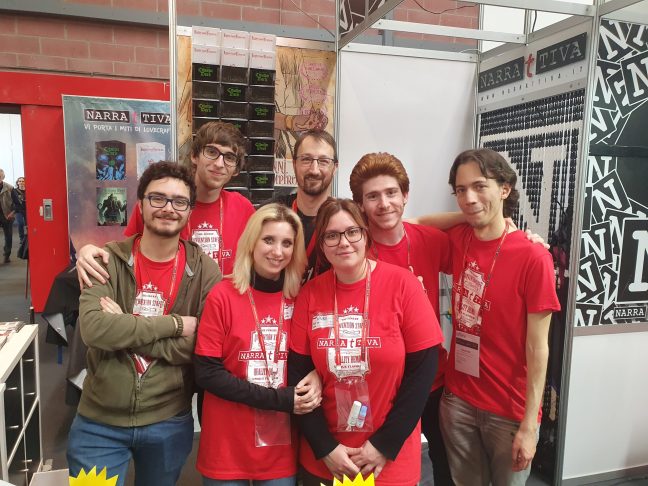
Me with some of the Narrattiva team
The Narrattiva team were a very welcoming bunch.

My first day was setting up the stall before the convention. A different experience from what I’m used to – the Narrattiva team had a sort of Ikea-style build-it-yourself booth which initially seemed like madness but looked very good once built. Even if the chaos around the floods meant they needed to do things unconventionally – see the video below for what I mean!

My first takeaway from the convention, on day 2, was that Italian gaming publishers are very showy. We had holographic displays on our booth, showing off the products Narrattiva produce. Next door was a massive table carved to look like a game board. Down the way, an area made up to look like a prison cell you could play Heroquest in. Massive battlemaps big enough to walk on, a room-sized Rubiks cube, and much more. They made UK conventions look a little boring. I’m honestly not sure how much of this is important and effective marketing, and how much is just an arms race of showing off. It does look very cool though.

A gorgeous wooden table carved into a game board.
So cool.

At the convention my main activities were signing books and running games. Honestly, I don’t think I’ve ever signed so many books. I came in thinking Italy was the place in the world where our games are most popular and the convention confirmed it, with more copies of Lovecraftesque sold than we’d normally do at home. I was frequently approached by very enthusiastic fans who wanted to tell me how much they loved the game, and by designers whose games we have influenced. It was a bit like being a minor celebrity for the week, and that was rather lovely.

As for running games, the flooding meant that the printouts and other materials I had hoped to have never materialised. But luckily I came to the convention armed with a prototype set of cards for Lovecraftesque second edition. These proved invaluable and worked even better than they have during online playtesting. The cards made everything smoother and easier to explain, and the prompts helped to grease everyone’s creative wheels. This was so effective that we managed to play a speed run in 90 minutes, which I think is a record for me. (I think the ideal run time for Lovecraftesque is more like 3 hours, but it’s very easy to cut this down if you need to.)

Playing Lovecraftesque 2e at Play Modena
I display my uncanny ability to close my eyes at the wrong moment.

Narrattiva had set up a 24-person “massive game” of Lovecraftesque (would have been 50 person but for the floods), which was a first for me. 7 or 8 individual games of Lovecraftesque were linked together. The premise was that the main character on each gaming table was the beneficiary of the same will: each character inherited a different house and also an item (which was provided as a physical prop in a box we had to open). There was also a “telegram” system where we could send messages to other tables if we wanted to. In the event, my table did a fairly ordinary (i.e. good, fun) game of Lovecraftesque, without making much use of the props or the telegrams, but I liked the idea of it and there was a certain buzz about playing the game in a room full of other people doing it at the same time.

Indeed my second big takeaway from the convention was the focus on play. Every booth in the convention had its own play area, and many “booths” were nothing more than a set of play tables. Organised play was a standard part of having a booth, and booking a session to play with me personally was part of Narrattiva’s sales pitch for the event. Offering massive/mega-games was an important part of the show. In the UK trade halls are essentially nothing but giant retail areas; they might be next door to a big play area, and the companies involved might offer games, but it all feels a bit separate. Given that we’re all interesting in gaming, presumably, to play games, this now feels a little odd. On a related note I heard from the organisers that they do something called “Play on tour” where they set up gaming tables at other (non-gaming) events around the country, including for example local festivals and scientific conferences. I would love it if we did that here in the UK.

Of course, there was also delicious food. I ate the local gnocco fritto, a kind of fried dough served with cheese and cured meat. Naturally there was also wonderful pasta. I had local wine (fizzy red wine served cold – unusual but very nice) and delightful limoncello brought to the convention by a fan of Lovecraftesque. I made myself into a typical Englishman by constantly asking for “un piccolo po di latte freddo” with my tea.

With the convention being in a peripheral part of town I only saw the centre of Modena on the morning before my return flight, but the convention organisers very kindly drove me in to have a little stroll around before rushing off to the airport.

Gorgeous Italian cathedral
Modena cathedral is striking in white stone.

I want to thank everyone at Narrattiva, particularly Michele, Pietro and Filippo (who acted as my translator on various occasions), and Matteo and Marco from the convention team, for being such wonderful hosts and managing to make my stay friction-free despite all the problems. I had a fantastic time and I hope to return one day.

Why we’re using Backerkit for Wreck This Deck

We’ve done four TTRPG crowdfunding campaigns, starting with Lovecraftesque (first edition) in 2015, then Flotsam, Bite Marks and Last Fleet. All four were on Kickstarter. We’ve had some great success with Kickstarter. But for Wreck This Deck, we’ve decided to go with Backerkit, and I want to talk about why.

First a brief plug for Wreck This Deck. It’s a solo journaling game of demon summoning and deck crafting, where you trap demons in ordinary playing cards by defacing the cards: paint them, stitch them, burn them, scrawl on them. It had some great success when we first released it during lockdown and we’re now ready to give it a print edition. If you like the sound of that then you can pledge on our Backerkit crowdfunding page.

When we first started crowdfunding, Kickstarter was more-or-less the only game in town. Indiegogo was there, but it just didn’t look as attractive, and the campaigns on there didn’t seem to do as well. Kickstarter was an accessible, simple way to get into crowdfunding – and it rewarded its users with what seemed to be a pretty good throughput from people who were just browsing the site.

But Kickstarter has made some weird moves recently. From the resistance to recognising the union, to the flirtation with crypto, it’s simply not been presenting an attractive face to ethical publishers and backers. And for a long time, Kickstarter has seemed complacent: for years it wasn’t even possible to put alt text on images, despite us writing to them to complain about the accessibility implications. (This now appears to have been fixed, thankfully.)

Perhaps in response to the diminished reputation of Kickstarter, there has been a growing set of rivals. Projects using these rivals have seen mixed success. It’s always a risk to move from a popular marketplace into somewhere new. And so there’s a risk of a vicious cycle, with alternative platforms seeing poor outcomes, putting off creators from using them.

Enter Backerkit. This is a platform that already has a lot of understanding of the crowdfunding market. We’ve been using them since our first campaign to provide post-campaign support, tracking our backers, generating helpful post-campaign surveys, managing our digital rewards and so on. Their customer service is second to none: when I’ve had problems working out how to do something they will send me a custom-recorded video by one of their staff made just for me, showing me how to do the specific thing I wanted. Where our Kickstarter campaign pages have always been approved without ceremony, Backerkit actually sent us detailed feedback on the Wreck This Deck campaign page, enabling us to improve it. And their functionality is great.

Backerkit has launched a full-blown crowdfunding platform of its own and it’s shown some pretty good success stories. But much more important, they’ve shown that they know how to run a crowdfunding platform. Their setup is flexible, functional, and well integrated with the kind of tools you need to manage a campaign. And as previously remarked, they have great customer service – both for us as the publisher and you the customer.

It felt like a risky move. We are all too aware of the potential for our campaign to lose visibility because Backerkit is still a relatively small player, with less “passing traffic”. But we think it’s the right move at this time. And early results from the campaign suggest we’ve made a good call. Of course we’ll never know how it would have gone if we’d used Kickstarter, but for a zine campaign Wreck This Deck is doing incredibly well at nearly 350 backers after 1 week, and that’s included a fair bit of people coming from within Backerkit’s website.

Of course, we’re not saying Kickstarter is evil, and we may well use them in the future. So far the crypto flirtation hasn’t come to anything, and they’ve shown they can improve by (eventually) recognising the union and offering alt text on their images. This isn’t some kind of principle-driven rupture. But we do hope that we can be part of a greater move to diversify the crowdfunding market so we’re not all dependent on one big provider. Having that competition will likely be better for Kickstarter too, in the long run.

So anyway, that’s a little insight into why we’re doing this. We’ll be watching closely how well Wreck This Deck does with a view to deciding what to do with our next big project: Lovecraftesque second edition. Watch this space!

May game: Gelatinous

[Gelatinous was our May patreon game. It has now been taken down but will show up on the Black Armada itch store very soon.]

Hello everyone!

You may recall that I finished work at my former day job about a month ago. I have been working myself pretty hard since then with preparations ongoing for the Wreck This Deck crowdfunding campaign (sign up to be notified about that here) and a ton of work to get Lovecraftesque second edition moving, as well as lots of boring business-related stuff. Alongside all this, I wanted to make sure that I got the Patreon going again, after what can best be described as patchy service.

Gelatinous is the first game of the new era. It’s a light, slightly silly game that I’ve been thinking about for a while. I like snacking, and I like drawing maps, and I like games. Gelatinous combines these three things into a fun game where you imagine your life as a gelatinous cube, consume snacks to represent your prey, and write little in character reviews of what you ate. I’ve been playing it a bit on social media using the #Gelatinous hashtag. It’s simple and quick to play and a lot of fun, and what better excuse to vary your snack regime?

Do tag me in if you play it on social media, I love to see people playing our stuff.

Next month I’m planning to release Polis, which is a city-building game using the same DNA as our earlier release Biome (and which longstanding patrons will recall is related to Microscope). Polis is about creating a settlement and watching it grow into a city, diving into the lives of its people over the years and centuries. Best of all, you get to make a map (I love maps). I’ve started playtesting it in the last week and it’s very fun.

Happy gaming,

Josh

How to be a cooperative player

Addie Stardust on Twitter asked for tips on how to be a cooperative player, and it turns out that I have some thoughts about this.

Cooperation means working together to make the game better. This might mean working with the GM but it also means working with the other players around the table. An important starting point here is that WE are working TOGETHER. So it’s not just one person being a cooperative player and helping everyone else, it’s a collective effort, and you get to look after yourself as well as the others. Ok? Let’s go.

The first step in cooperation to make the game better is understanding what would make the game better, and that is mainly about understanding what the people around the table want. So this means three things:

  • Listening to what other people want;
  • Actively soliciting people to better communicate what they want; and
  • Being clear yourself on what you want and signalling it to the other players.

Obviously it will be hard for anyone to cooperate if they don’t understand what each other want. “What you want” means: what you’re interested in; what kind of story you want to tell; what kind of themes you want to address; what kind of things you want to do; what kind of character you want to play; and so on. Some games do a great job of helping to structure and codify these things, greasing the wheels of the conversation. But even if your particular game doesn’t do that, you can do it for yourself. One part of that is getting the information from the other players, by paying close attention and listening to what they’re saying and doing. If they’re not communicating or you’re not clear, or if you think there’s more to know, you ASK them.

The other half of this is playing your part by being clear about what you like. Don’t wait to be asked – the more you share of your preferences, the better other people can help you to enjoy the game. Plus you’re leading by example and likely encouraging others to reciprocate by telling you what they like.

Now that we understand what each other want, we can work to give each other the game we’re looking for. This means consciously and positively:

  • Engaging with the direction and themes of the story
  • Playing towards the role and image of the characters
  • Building connections and synergies with the rest of the group

Engaging with the direction and themes of the story is what, in a traditional GM’d game, would often mean “following the GM’s plot hooks”. In other words, the GM has prepared a story, therefore you engage with that story. You swim with the current rather than against it. But also, whether you’re in a GMless game or a GM’d game where the group are more closely involved in setting the direction, you follow the other player’s “plot hooks” too. If the players have said they want to engage with particular themes, then it’s just as important (maybe more so) to help them do that as it is to follow where the GM is pointing the story. If we’re all here interested in romantic rivalries, then we can have fun playing into that space by flirting, showing jealousy, opening up new relationships, and so on. And we might choose to ignore the GM’s plot hooks to do this, if it seems like that’s what the group are most interested in. In fact it’s just as much the GM’s role, as a cooperative player (the GM is a player too), to step back and take their foot off the gas, making space for us to address these themes.

Of course even better is if we can cleverly make the GM’s plot hooks and our desire for (in this example) romantic rivalries fit together. A really skilled GM will find out about this interest at the start of the game and build their plot hooks around it. And then we as a group will skilfully use the GM’s plot hooks to get the juicy romance plot we wanted. That is what cooperation looks like: everyone striving together towards the story they want.

Playing towards the role and image of the characters is what has been called elsewhere “playing to lift up”. It means having a clear idea of what each of the characters want to do, and how they want to be seen, and taking action to support that. A really basic approach to this is sharing and (where appropriate) ceding the spotlight so they can have their time in the sun. But you can be much more pro-active than that. For example, if another player describes their character as a leader, then that means they want to lead. A leader has to have people who look up to them, who listen to them, who follow them. As a cooperative player, you can help with that by portraying your character looking up to them, listening to them and following them. You might even at times step away from situations where you are naturally inclined to lead, to make space for them to do so. You might give them explicit encouragement when required, saying “these people need your leadership” to prompt the player to push the character into the role they wanted.

You’re like a backing singer or supporting actor working to make the main character look good. This doesn’t have to mean “look good” in the sense of “look like a badass” – if the player wants their character to be comic relief, you can help them do that too. If the player wants tragedy and pain, you can be the one dishing it out. The point is to know what they’re after (again, if you aren’t clear, ask) and help to give it to them. This may mean you have to tweak your own idea of what your character would be like. Hold your ideas about your character loosely, making space to adjust them to be a better supporting act for other people. Perhaps you didn’t really envisage your character as someone’s follower. But take a moment to think – could they follow another person? Maybe they are a leader in some contexts and a follower in others? Try to keep your character malleable enough that they can fit in with what is going on at the gaming table.

As with the story themes, this is a job for everyone, including of course the GM. And it’s also important to say that you get to have your time in the sun too. Sometimes you’ll be stepping back to make space for someone else’s preferred role to play out, but sometimes you should claim your space in the spotlight.

You can be even more cooperative here by inviting others into your spotlight time: if you’re the leader, ask if anyone wants to be your follower right now. If you’re the protector, ask if anyone wants to be protected. This is where building connections and synergies begins to become important. Right at the start of the game, you can look for roles that are complimentary (leader/follower; mentor/student; unrequited lover/oblivious object of desire). You can also do this in real time during the game, identifying where your cool action in the spotlight could involve someone else. Invite others into what you’re doing. You can come up with any pretext you like: perhaps there’s a genuine logical reason why you’d want a wingman for this mission, or perhaps your character just feels like some company.

The reverse also applies. Don’t be shy in asking if you can get involved in what other people are doing. Having two people in the spotlight at a time means twice as many people are having fun, but also potentially they’re having fun in ways they couldn’t otherwise. Sure, the sneakthief could just go off and do a cool stealth mission on their own. But might it be even more fun for them if there’s another character (you) tagging along, permitting the action to be peppered with conversation, perhaps allowing them to rescue you from a tight spot.

Stepping into someone else’s spotlight is a bit risky, because it could feel like you’re hogging the spotlight or treading on their toes. This is a good time to take the conversation out of character and ask the player whether they would enjoy having you along rather than just having your character ask theirs. Once they’ve said yes you can continue to exercise your judgement about how best to support them and lift them up, enhancing their enjoyment rather than crowding them out.

You can weave the whole of this together into the most beautiful connections and synergies if you want to. The themes of the story can support the desired roles and relationships, and vice versa. That’s what a really tight design can do, by the way – some games dish out character archetypes, relationships and mechanics that are all mutually reinforcing. But you don’t necessarily need the game to do that for you if you are actively working together to do it yourselves. There’s probably such a thing as a too tightly-woven mesh of themes, roles and relationships; you may be going too far if you’re just pre-deciding everything that’s going to happen in the game. But definitely having awareness of what everyone around the table wants and consciously working to play into those things, will create a more cohesive and fulfilling game for everyone.

I personally think that cooperation is the apex skill for roleplayers. You can be an amazing character actor, a genius at deploying the game’s mechanics, an incredibly evocative narrator, a brilliant problem solver, and many more besides. These all can make a contribution to a great game. But if you’re taking those skills and pointing them at the other people at your table, positioning yourself to connect with them and support them in what they’re doing, you’re going to come off as a much better roleplayer, and get a much richer game to boot.

Blog post: How to be a cooperative player

Addie Stardust on Twitter asked for tips on how to be a cooperative player, and it turns out that I have some thoughts about this.

Cooperation means working together to make the game better. This might mean working with the GM but it also means working with the other players around the table. An important starting point here is that WE are working TOGETHER. So it’s not just one person being a cooperative player and helping everyone else, it’s a collective effort, and you get to look after yourself as well as the others. Ok? Let’s go.

The rest of the blog post is continued on the Black Armada website. 

Lovecraftesque part three (episode 64)

Links to this episode on:

We continue our run of the new second edition of the classic indie horror game, Lovecraftesque.

Jonathan visits the Hotel’s resident doctor, whose curious questions – and the strange ambience – leave him feeling very uneasy.

A trip to the town’s sinister-seeming library reveals a strange piece of history.

If you are interested in Lovecraftesque you can find the first edition of the game here: https://blackarmada.com/product/lovecraftesque/

If you would like to be notified when the second edition crowdfunds, you can join the Black Armada mailing list here: https://blackarmada.com/black-armada-mailling-list/

Our players are:

  • Joshua Fox https://twitter.com/armadajosh or https://dice.camp/@armadajosh
  • Becky Annison https://twitter.com/BeckyAnnison or https://dice.camp/@BeckyA
  • Eadwin Tomlinson
  • Nick Bate https://twitter.com/ickbat
  • Sue Elliott https://twitter.com/SuefaceTM

Black Armada create and publish TTRPGs here: https://blackarmada.com/

Nick creates and publishes TTRPGs as Ickbat here: https://ickbat.itch.io/

The music is Orange Button by Esther Garcia.

Links to our current Patreon games

If you are new to our Patreon or looking for our latest games and want to save a bit of scrolling, here are the current links to what you get as a patron.

At Crew level, you currently have access to these games:

  • The Big H, a game about a superhero who becomes a tyrant, where you play the lesser heroes who once looked up to them and must now fight them.

  • Advent of adventure, an advent calendar solo game in which you play a Christmas elf who must save Santa from a dragon.

  • Ex Tenebris, a gothic space investigation game, currently playtesting.

At First Mate level, you also have access to work in progress drafts of our bigger games.

Patrons and non-patrons alike are welcome at the Black Armada discord.