Rules do not elide

A rule can be a statement of what you can do, what you must do, or what you must not do, and it may also describe *how* you must do a thing. Rules have all kind of uses. In tabletop roleplaying games, one of those uses is to simplify arguments about how things ought to play out in the fictional situations we imagine and describe at the table. This has led to the claim that “rules elide”, and from what I can glean from the froth and din of internet discourse, some people think this is a very important claim*. But I am going to argue this is, at best, a partial representation of what rules do.

Why might we say that rules elide? Well, if you haven’t already, you can go and read the article where this idea was first publicly described (though it has now been deleted and is only available on backup, so don’t harangue the author** about it – which, come to think of it, don’t do that anyway). From reading that article, I take the essence of the “rules elide” claim to be this:

  • Without any rules, we describe the fiction in intricate detail, carefully characterising each little bit of what is happening. For example, we might describe each step, slip, swing and cut of a sword fight.
  • Rules enable us to shortcut that by instead rolling a die and saying “I win”, skipping out all the detail in between.
  • Therefore, rules elide the details of the fiction. Not necessarily all the details – and indeed, by eliding some parts, they effectively highlight what is left – but nevertheless, this is their role. Rules elide.

Whenever one describes another person’s argument there’s a risk that this leads to simplification or misrepresentation but I think the above is a fair summary of the “rules elide” argument.

The problem is that the first bullet isn’t true.

Without any rules, we might indeed describe the fiction in intricate detail. But we might not! In the linked article, an imagined player group describe the picking of a lock by working through the movements of pins and tumblers and whatnot. But that is certainly not how I would handle the picking of a lock. Here are a few ways I would think about doing it:

  • I might make a quick decision either way and describe what happens. “Nope, you can’t pick it, and your lockpick snaps.” “Cool, it opens.”
  • I might describe the lock and ask the player picking the lock what happens. “This is a top quality valyrian steel lock. How good a lockpicker are you, do you think you can open it?”
  • I might present a “yes, and” or “no, but” sort of approach. “Sure, you can open it, but it is going to take a while and you can hear the footsteps of the guards approaching, what do you do?”

You could of course argue that somewhere in there I’m using rules. My ability to “make a quick decision” rests on some rule, whether explicitly stated or implied, that I have a right to make a decision (probably because I’m the GM). But in reality if we started trying to roleplay together without discussing any rules at all, it is very very likely that at some point someone would skip over most of the fictional detail and make such a decision. Indeed, the decision to say “you find a locked door” is such a moment. The casual elision of details is actually a fundamental part of storytelling and imaginative play, regardless of whether you think there are rules involved.

So it’s not the case that roleplaying without rules is inherently very detailed.

But more than that: rules can actually supply detail where none would otherwise exist.

Consider the classic case of a game of cops and robbers. “Bang bang! You’re dead.” “No I’m not!” In this game, we skip over enormous amounts of detail. I point my two fingers at you and say bang bang, you fall over or you don’t. At no point do we consider what kind of gun or ammunition we’re using, what armour we might be wearing, how good my aim is, the potential elements affecting my aim such as distractions or (at longer ranges) wind. We are eliding the heck out of that gun fight.

I defy anyone to look at the crunchier roleplaying game manuals and tell me that these games elide compared to this simple roleplaying activity. Looking at my old copy of Shadowrun 4th edition, I see 2 and a bit pages of rules for adjudicating initiative, 6 and a bit pages of rules for different types of ranged fighting, plus 9 pages of details about different types of ranged weapons (with pictures!) This is not eliding *anything* relative to how I would normally conduct a firefight in a roleplaying game; in fact if I take it seriously as a set of rules, it enormously expands the level of detail and precision I would use in narrating such a fight.

So at the very least, I think we have to say that rules don’t always elide. Perhaps they are always eliding compared to some perfect simulation of reality, but that is certainly not the default or most commonly observed state of imaginative play when unmediated by rules.

What, then, will we say about rules? Rules are a way of guiding the conversation. We can drill into the details we find interesting, as Shadowrun players presumably find weaponry. We can skip over the details we don’t find interesting, as many other games do with the details of the same weaponry. We can remove arguments over who went bang bang first and who is now dead. We can specify how decisions should be made, and who gets to narrate the outcome of those decisions, as when Forged In The Dark tells us who gets to decide what dice to roll and who gets to decide the level of risk and effect. We can quantify things that would otherwise remain vague, as with hit points in D&D or sanity in Call Of Cthulhu. We can introduce details that don’t exist in the real world, like the characteristics of a monofilament whip. We can force the conversation at the table down particular lines, as when in Ten Candles, if the last candle goes out, the characters die regardless of what they may have had planned. We can force a player to describe something they hadn’t even thought about until a moment ago, as when in Apocalypse World a character is suddenly asked to tell us their secret pains.

Rules can sometimes elide. But more often, rules specify. Rules focus. Rule describe. Rules intrude.

Rules are a magical way to shape our conversation at the table, to direct play and to bring imagined worlds to life. Used unwisely they can be blunt instruments that get in the way of good storytelling. But the best rules help us tell stories we almost certainly wouldn’t have told otherwise. They mostly don’t do it by eliding.

If you enjoyed this blog article, please encourage me to make more by supporting the Black Armada Patreon.

*Side note: I am far from the most up-to-date person on internet discourse. I think this claim may be fairly old, at least by the frenetic standards of discussion on X and other such places. I’m sorry if I sound like an old man shouting at clouds.

**Which, to be clear, I have no idea how important the author thinks “rules elide” is as a statement or how sweepingly they intended to make that statement. Perhaps this entire article is a statement of the bleeding obvious – ironically I kind of think so. Still, discourse eh?

1 year of self employment

A year and a day ago I left my office in the UK civil service for the last time. I started a life of adventure as a full time game designer. So far I haven’t looked back!

Here’s what I’ve done in my first year:

  • Run two successful crowdfunding campaigns, fulfilled one of them entirely and broken the back of the other one.
  • Built the foundations of a new game system which will form the core of a number of future releases, and commenced playtesting of that system.
  • Learned how to use Roll20 and designed the virtual playroom for Lovecraftesque in it.
  • Created 7 new games through our Patreon and supported Becky to publish 2 others.
  • Published 40 episodes of our AP podcast Black Armada Tales and watched the audience steadily grow.
  • Attended 3 major conventions including one overseas.
  • Set up a bunch of useful systems that will support our business in future.
  • Kept the business afloat and paid myself enough to live on.

I’m pretty satisfied with that for a first year’s work. This year will be different – we are only at the start of the design journey for the stuff we’re working on now, so there will probably be less publishing/crowdfunding activity and more development work. One thing I discovered this year is that it’s quite hard to manage a serious crowdfunding to publication cycle while also designing new stuff! Finding a rhythm is going to be one of my challenges.

All of this has been helped enormously by the enthusiasm and encouragement of our fans. Whether you’re one of our patrons, a crowdfunding backer, a podcast listener or someone who has helped to spread the word about our stuff, it is all very much appreciated.

Onward to the next year!

January game – Heartbreaker

Heartbreaker was our January patreon release. It has now been taken down, but it will appear before too long in our https://blackarmada.itch.io/.

Hi folks

January’s game is Heartbreaker, my tribute to Elric of Melnibone, the fantasy book that made me fall in love with fantasy books. It’s a Lovecraftesque hack, or perhaps closer to a Bleak Spirit hack, but with some significant changes. Like those games, Heartbreaker gives you a single protagonist who you take turns to play, and a weird world that is revealed one piece of Lore at a time, again taking turns to do so. But Heartbreaker comes with a Companion and Villains that you can talk to, as well as a simple combat system in which the protagonist may win or lose, creating ups and downs in their journey.

Here’s the blurb:

In a strange world of decaying empires and mad gods, you are a fated warrior and sorcerer bearing the cursed sword, Heartbreaker. The game follows your adventures as you wander the land. You will meet dangerous monsters, deadly rivals and embattled victims. All desire you, whether as an ally, pawn, or saviour. You have the power to shape this world. Are you ready to meet your fate?

This is a GMless game for 2-5 players inspired by the stories of Michael Moorcock. You share the central character, their sword and the strange peoples and creatures they encounter.

Using a core structure and mechanics similar to Lovecraftesque and Bleak Spirit, Heartbreaker explores fantastical worlds and epic struggles in a world of ravening hordes and mad gods. You will wield your sorcerous powers and cursed sword to bring victory – but at what cost?

For this game I’m trying out distribution through Itch. If you follow this link, you should be able to link your itch account and access the file through itch, meaning it will always be in your itch library, and if I ever update the game you will get an updated copy. I’m really interested to know the reaction to this – is it helpful to share stuff in this way? If you’ve used it with other Patreons you support, have you had any issues with it?

Just in case the itch thing is a disaster for anyone, I’m attaching the game to this post as well.

Finally, I want to mention that we’re taking a break from releasing Patreon games in February, and maybe March/April depending on how things go. Running two crowdfunding campaigns in rapid succession while maintaining a Patreon and a podcast has taken it out of me a bit, and I feel like I’m having to run just to stand still. Becky is currently struggling to balance work and game design, so this is a break for her too. I hope to use the intervening time to design more games for you but at a more leisurely pace, and perhaps build up a bit of a buffer of already-designed stuff so I’m not quite so under the cosh. Of course, We’re pausing Patreon payments so you won’t be charged during this break.

I hope you enjoy Heartbreaker, and we’ll be back before you know it 🙂

Cheers

Josh

December game: Advent Of Abomination

Advent of Abomination was our December game. It is no longer available to patrons, but is now available on our itch store.

December’s Patreon game is out early*, to enable those who are craft-inclined to print and assemble it. Because as we trailed last week, this is an advent calendar TTRPG!

Advent Of Abomination is an advent calendar that’s also a solo folk horror TTRPG. Open a door every day to reveal journaling prompts and drive your character to their doom just in time for Christmas day.

This year, you’re alone for Christmas, staying in a remote cabin far from the beaten track. No friends, no family, just you. It could be pretty miserable – but you’ve surrounded yourself with festive things and delicious holiday food. Things look like they’re off to a great start as a thick coat of snow has fallen. You are settling down for a lonely, but relaxed holiday. But you’re not as alone as you thought. Something inhuman stirs, and it’s about to tear your quiet little Christmas apart.

This Christmas, experience wonder and terror with Advent of Abomination.

Advent Of Abomination includes print-ready files with marks for cutting your own advent calendar doors. It also includes a bookmarked PDF which you can use as a virtual advent calendar; using the bookmarks to navigate will avoid spoilers.

As mentioned in our last post, we are going to be printing and hand-cutting a limited run of these. Today (Thursday 23 November) is the last day to order one, and as Black Armada patrons you can use the code “patreonadvent” to get 30% off the cover price. We will post your copy out to you, or you can collect it at Dragonmeet. Order that here: https://blackarmada.com/product/advent-of-abomination/ 

Happy holidays!

Josh and Becky

*We charge monthly so this hasn’t triggered any extra payments.

November game – Gladiators 2050

Gladiators 2050 was our November release. It has now been taken down, but will be available soon on our itch store.

Over the last few months Becky and I have been re-watching the classic 90s TV show Gladiators. This is the UK version – the US version came first, but the UK one will always be closest to our hearts. The show still stands up, and the cheesy 90s attitude remains much preferable to the serious, grumpy noughties reboot. (We’re also very excited about another possible reboot happening later this year – even if there’s no sign of it actually being aired!)

One thing we noticed watching it from fresh is that we had become connoisseurs of the events in the show. We took to critiquing events and imagining how they could be redesigned. It wasn’t long before I started thinking about writing a TTRPG version. Gladiators 2050 is that game.

In Gladiators 2050 you’re playing the latest reboot of the show, an ultraviolent hybrid of Gladiators and The Running Man. You will each get a Contender who is trying to win that sweet holiday in Barbados, but also one or more Gladiators working to end their run – and perhaps, end their life. 

You’ll take turns to procedurally generate an event for your Contenders to try and beat. You’ll then run your Contenders through it and, if they survive, interview them at the end. Once you’ve played through a few events, you’ll each create one chunk of the dreaded Eliminator, and find out who has won the competition.

I had a blast writing and playtesting Gladiators 2050 – hope you enjoy it!

Cheers

Josh

October game: Cyrano In Love

Cyrano In Love was our October release. Its now been taken down, but will be available soon on our itch store.

Hi folks

Before I start: did you know that Lovecraftesque second edition is crowdfunding at the moment? If you don’t know it, Lovecraftesque is a storytelling game of creeping eldritch horror, focusing on a lone witness who is rotated around the group, and where the mystery emerges from clues the players create. We’ve created a fully updated game, driven by creative prompts on cards, and supported by updated rules and the most accessible rules and reference materials yet. It’s also the most gorgeous edition yet with brand new illustrations, including hidden art you can reveal using the (included) UV flashlight. And there are 18 scenarios written by diverse authors, bringing fresh new perspectives and settings to cosmic horror. Check it out! 

With that out of the way: It has been a busy old time for Black Armada. I’ve been nose to the grindstone preparing the above crowdfunding campaign, and Becky is juggling several recruitment campaigns at her work while preparing for COP (the biggest global event for climate change policymakers). It’s wonderful to get to work on these things, but also exhausting.

Anyway, this hasn’t stopped us from working on making lovely little games for you! This month’s game is by Becky, and it’s called Cyrano In Love. As the title suggests, it’s based on the famous Cyrano De Bergerac story and in it you play through that story, with each of you adopting the role of one of the three main characters. If you haven’t encountered Cyrano De Bergerac, it’s a romantic play telling the tale of the eponymous Cyrano, who is secretly in love with Roxanne, his friend from childhood, and expresses this through giving advice to the young and brash Christian, who seeks to woo Roxanne. It’s a brilliant story and very fun to play with at the table. You can use the game to play it more or less as it appeared in the play, or expand the story into new settings such as the included Space Station Gascony 2040.

I hope you enjoy playing it as much as we did!

Josh

Lovecraftesque second edition is available to pre-order

Lovecraftesque. The eldritch horror roleplaying game where you create the mystery at the table. Pre-orders now open. Image shows the Lovecraftesque box cover with a skull-like monster lurking behind a lone character in the woods. Alongside this are the new rulebook with a striking red-and-white cover, and a spread of cards from the new edition.

Lovecraftesque second edition successfully crowdfunded in late 2023. You can now pre-order it here, or if you’d like to know more, read on!

A Storytelling Card Game Of Eldritch Horror

Lovecraftesque is a storytelling card game of creeping cosmic horror, emulating the tone and pace of eldritch horror stories. The game will guide you to create the story of a lone individual who stumbles upon clues to a terrible evil. It creates slow-building, brooding horror that the main character at first dismisses, until all too suddenly it becomes impossible to deny. The ending will certainly be bleak, and the main character is likely to meet their doom.

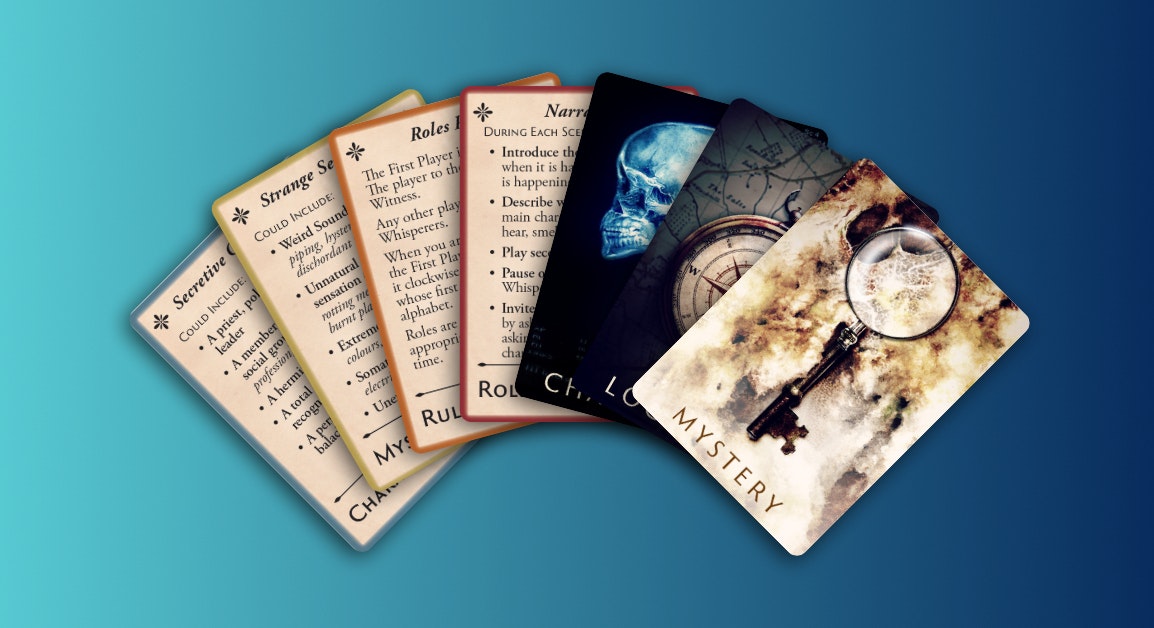
A mock up of the cards used to play the game
Brand new cards help streamline gameplay and inspire your group

Lovecraftesque is an emergent mystery game, which crafts a story out of clues that you take turns to create. The game includes hundreds of creative prompts to help you generate your story and guide the main character towards a confrontation with cosmic evil. You take turns to drip weird events into the story, building up your mystery one clue at a time.  Each player creates a secret theory about the horror and the truth about the horror emerges from those theories. By the end you’ll reach a chilling climax that none of you could have predicted at the start.

Lovecraftesque is easy to learn and teach, simple and intuitive to play, with hundreds of prompts to fire your imagination. It can be played with 1-5 players in around 2 hours.

Lovecraftesque is created by Josh Fox and Becky Annison of Black Armada Games, the award-winning publishers who brought you Wreck This Deck, Last Fleet, Flotsam: Adrift Amongst The Stars and Bite Marks.

A mock up of the Lovecraftesque core box
A New Edition

We created the first edition of Lovecraftesque back in 2015. It was our first game design project and we were delighted with its success. It’s received critical acclaim, won awards and gained thousands of fans around the world. But we were new to publishing then, and the costs and risks meant we were unable to realise our full vision for the game. In this new edition we’ve created the game we always wanted to.

The second edition is fully card-driven. It gives your group more support for their creativity through prompt cards that help you get your story set up and populate it with interesting clues, characters and locations. The story will seem to write itself.

There are also brand new card-based scenarios to get your story off to a flying start. Check out the scenarios list to see the incredible range of fresh exciting settings for eldritch horror, written by a diverse slate of talent from across the industry. Like the rest of the game, these are written on cards, meaning you can easily mix and match to make up your own weird tales.

With the new card-driven approach the game is even easier to learn, teach and play. The rules and structure of the game are written into the cards and your progress is tracked on the board, so you always know what you’re meant to be doing. As always we include teaching text to make it easy for you to learn and teach the game at the table, and tools to avoid the stereotypes of Lovecraft’s own work.

We are also commissioning new art by Vincent Sammy and Paul Tomes to make the game look cooler than ever before.

Lovecraftesque second edition will be available as a boxed set with the rules and all the cards you need, and as a virtual tabletop for online play.

Lovecraftesque is crowdfunding from 10 October to 9 November 2023. Pre-order now and become one of the first to back the project!