Stance and stancibility

So, where was I? Oh, yeah: stance.

Le Forge has this to say about stance:

  • In Actor stance, a person determines a character’s decisions and actions using only knowledge and perceptions that the character would have.
  • In Author stance, a person determines a character’s decisions and actions based on the real person’s priorities, then retroactively “motivates” the character to perform them. (Without that second, retroactive step, this is fairly called Pawn stance.)
  • In Director stance, a person determines aspects of the environment relative to the character in some fashion, entirely separately from the character’s knowledge or ability to influence events. Therefore the player has not only determined the character’s actions, but the context, timing, and spatial circumstances of those actions, or even features of the world separate from the characters.

So I was thinking to myself, actor and author stance are basically about playing a character, in the former case according to the character’s motivations, and in the latter case according to your motivations as a player (retro-justified as needed).

Director stance appears to be about playing the environment. But wait: we can subdivide this further also.

Let’s say that Regulator stance is playing the environment in accordance with the fictional logic of the environment. So, for example, you’ve just dived into the Niagara Rapids wearing naught but a polka-dot bikini and a baseball cap. In Regulator stance, I’m afraid you’re toast. You are swept away. The last we see of you is a flash of polka, a flailing arm, then nothing.

Meanwhile, God stance is playing the environment in accordance with your own motivations. Ok, you aren’t likely to survive a headlong dive into the Niagara Rapids, but I’d quite like it if instead of dying, you find yourself hanging by a delicately positioned tree branch, and just within sight of your arch-rival… what will he do now?

The same breakdown can be applied to less environmental questions. Say I want to know “will the inhabitants of Endor rise up against their invaders?” – I can resolve that by thinking about their motivations and the things we know about the situation, or I can do it according to what I think would be interesting, or what I’d like to see. Maybe that’s Sociologist stance and Dictator stance, I dunno.

So there we go. Director stance isn’t just a monolithic thing you can do, it means decisions justified in different ways, just like when you play a character. Maybe it would be simpler and clearer to divide the scope of decision-making in two. Actor stance when you’re playing a character, Director stance when you’re making wider decisions; Endogenous justification when you’re going with fictional logic or character motivation, Exogenous when you’re deciding for other reasons.

One last thing – in practice I almost never go into a pure Exogenous way of thinking. Basically if the fictional/in-character reasoning is overwhelming and obvious, I go with what that says. If it’s, like, 90% pointing in one direction then I’ll need a strong external reason to ignore that. If it’s less clear-cut, I’ll think more about what would be interesting, or just go with my whim. It’s still helpful to be able to clearly talk about the decisions we’re taking and the reasons for taking them, but it’s fair to say that these aren’t either/or.

Apocalypse World: Fronts

I’ve recently started a new Apocalypse World campaign and re-reading got me thinking about the Fronts system. Apocalypse World Fronts are basically a set of linked threats that the MC writes down with countdown clocks and stakes questions as a means to (a) give him interesting things to say that aren’t just improvised from scratch and (b) address one of the principles of AW which is “sometimes, disclaim decision making”. Anyway, there’s a prescribed format to them and what I’ll do here is analyse that format.

The fundamental scarcity. Every Front has a fundamental scarcity chosen from a list of eight (hunger, thirst, envy, ambition, fear, ignorance, decay and despair). The AW rulebook has almost nothing to say about the purpose of this, and I surmise that it serves to provide inspiration and keep everything apocalypse themed, nothing more. I have found myself struggling to identify a single fundamental scarcity for a given Front, and even the book’s example Front seems like it would fit with at least two fundamental scarcities. Maybe it could be handy to remind yourself what the Front is all about or to judge whether a new threat should be added to the Front, but mostly it feels a bit surplus to requirements once the Front has been written down.

Linked Threats. The whole point of having a Front is to add value to what a list of individual Threats would achieve. The example in the book doesn’t help us here. We have this mud-fish parasite which is infecting everyone, the waders who carry it and some bunch of thugs who enforce quarantine. Those all seem highly linked and could be called “the mud fish parasite front”. But then we have Dustwich, this person who wants to overthrow the hardholder. She seems unrelated, except insofar as the previous Threats will create pressure to overthrow the hardholder, aiding Dustwich. Anyway, my feeling is that Dustwich is a bit tacked-on, as though Vincent Baker felt that merely having the holding overrun by a parasite wasn’t interesting enough (and perhaps too faceless).

Still, I guess if you start from a fundamental threat – the mud fish parasite in this case – and ask what other factors bear on this threat, either as obvious  connected things like the waders, or things which push the other way like the quarantine enforcers, you’ve got something there. Asking yourself to generate linked Threats is an exercise in thinking about what else is implied by the existence of the core Threat.

The Dark Future. Every Front has a dark future which is what will happen if it is allowed to roll forward undisturbed. This is useful as a check for the MC – is this Front really threatening or have I created a situation the PCs can ignore? It could provide useful fodder for improvising, too.

Again, the example Front in the rulebook is unhelpful. In the example Front , the Dark Future is essentially “Dustwich takes over the hardholding”; the other threats in the Front are just things which serve to antagonise the people against the hardholder and over to Dustwich’s side. I mentioned before that Dustwich felt tacked on, and indeed because the Dark Future relates to Dustwich, it feels as though there’s no real relationship between it and most of the Front. If we imagine, though, that Dustwich were gone and the Dark Future were “everyone gets the mudfish parasite; lacking a healthy workforce, the holding grinds to a halt and one by one its members die or leave”, now we have a Dark Future that relates to the elements in the Front.

So with that imaginary alternative example Front, we can see more clearly that the Dark Future serves an additional purpose, which is to keep the MC’s mind on where the Front is going. Every time something happens the MC can ask – does this bring the Dark Future closer or set it back?

Countdown clocks. Countdown clocks are introduced as a thing relating to Fronts, but in actuality the book recommends they be attached to Threats. Regardless, they’re probably quite closely oriented to the Dark Future (or should be – again, the example Front lets us down here). They serve to provide a concrete sense of the factors that build up to the Dark Future, pacing for that build-up, and a way for the MC to drive that build-up without it just being on a whim “Bam, the dark future happens because I decided”. Having said that, what seems to me missing from the countdown clock concept is:

Triggers. This isn’t in the Front rules, but I think it should be. The book says the countdown clocks are descriptive and prescriptive. Meaning, if I get to 9 o clock then the mudfish parasite eats my head, but equally if for some reason the mudfish parasite should eat my head then the clock automatically advances to 9 o clock. All well and good, and this serves to avoid the clock becoming divorced from reality. But we’re still left with a clock that (absent the mudfish parasite eating my head of its own accord and thereby advancing the clock prematurely) ticks forward on the MC’s whim.

Contrast the injury clock on every player’s character sheet, and which ticks forward when you take harm, back when you are healed. There are rules for this; the MC can change it more or less on a whim but there is a logic that constrains him in doing so. So for me, the countdown clock needs triggers; every time the parasite infects a PC or a new group of NPCs, move the clock forward, for example. That way, aside from the obvious fictional trigger that if the events described in the clock happen of their own accord, you move the clock forward, there’s a separate, more inexorable trigger that if nobody does anything the clock will tick forward, which is at least somewhat outside the MC’s control. So you’re disclaiming decision-making, like the principles say.

Custom moves. One of the things that makes AW popular is its customisability. Custom moves, yay! I’m not sure these are really specific to Fronts but it’s obviously good to think about them when you’re doing your Front prep. Having the Dark Future, the Threats, the Fundamental Scarcity and all the rest in mind when designing custom moves will serve to give everything coherence and relevance.

Stakes questions. These are little questions you write about the fate of particular individuals or groups in the game world, and which you commit to answer using the game fiction’s internal logic. The book says they’re real important but gives little guidance on how they fit in with the wider Fronts framework, or even what committing to not answering the questions yourself entails.

The example questions mostly relate directly but not straightforwardly to the Threats in the example Front. The first and most straightforward is “who will fall prey to the mud fish parasite?” – ok, so I’m committing not to choose who gets it, which seems pretty tough. If I choose to put a non-infected character in a room with an infected character I’m almost making the decision, aren’t I? There will definitely be situations where I put two people on a collision course but let the PC’s actions decide whether they actually collide, sure; but I don’t really see how I as MC could avoid deciding some of who gets infected. Naturally I’ll do it based on the game fiction’s logic, but I would have done that anyway – the crucial question is, have I just fiated someone to infection or not? I think I’d have to if I used this example Front.

The other questions are less straightforward and more interesting for it. “Will Dustwich get a better life for her people?” This question tells me that even if Dustwich fails in taking over, there might be scope for a better life for her people. She won’t get a better life for them unless she overthrows the hardholder or someone else intervenes to make life better, so I can see the benefit of the stakes question here. The question is saying: the answer is no unless something happens to make it yes.

Another is “will Grief’s cover get blown?” – there’s a specific trigger for that in a custom move, so it’s very easy to see how the MC is disclaiming responsibility on that one. The final one: “Will Snug and Brimful stay married?” – great question, totally unclear how it will be resolved given that Snug and Brimful are throwaway names in the Front cast list. How does the MC commit to not deciding it? I honestly don’t know.

What is the point of all these questions? I presume that apart from getting the MC into the mindset of disclaiming responsibility, it’s to ensure the Front isn’t just about the central Threat rolling forward supervillain-style to take over the PC’s world, it’s about the impact the Front has on real people. But honestly, I’m not sure what the point of them is or how they’re supposed to work – as outlined above sometimes it’s obvious, sometimes not at all obvious how the MC will keep his grubby mitts off the decision-making process.

Do we need them at all? The book says that Fronts are fundamentally conceptual, not mechanical. I think that’s right; they serve a purpose of structuring the prep process and hopefully giving it coherence and direction without just making it into a one-way railroad.

So far my experience of this is limited to trying to write some Fronts for this game, and for the one that went before it. I haven’t found the process all that intuitive or helpful. I’m mulling over whether to pull the whole thing apart. For example, could my stakes questions be completely separate from my Fronts? I identify some characters whose fates I care about and ask the most obvious questions I can think of about them. Whichever Fronts and Threats intersect with those fates (including the PCs of course) can answer the questions for me, so they don’t need to be tied to a Front. Might it be better to ask what the fundamental scarcities are for the group as a whole, and just use them as an off-Front inspiration for generating new Threats and understanding the consequences of events in the game?

I guess the fact that I’m asking these questions suggests the elements of a Front have their uses, as outlined above, but I wish the AW book had devoted a bit more time to explaining how they were supposed to work and what the benefits of using them were.
 

Authorial boundaries

Many story games widen the scope of authorship beyond traditional boundaries. In Apocalypse World, the MC can turn responsibility for decision-making over to the players, asking them questions in a reversal of the more usual approach. In Microscope there is a highly defined process through which everyone playing the game can author almost any element in the fiction. But it is quite common to take a far less structured approach, leaving everyone to invent everything as and when they feel like it, and often blurring the lines between In and Out of character speech.

So for example, in a game of Fiasco I could start a scene by having my wannabe gangster tell his cronies “The plan is to knock off the Royal Bank of Scotland on Spencer Street.” Right there, I created a bank and a street – I didn’t need to tell the group about it Out of Character in the way that a GM might, my IC speech made it so. (Someone might reply “but there is no bank on Spencer Street”, which would confuse matters – improv actors would call this “blocking”, which is not a good thing at all.)

But my experience has been that when things are left unstructured and informal, not everyone will have the same ideas about where authorial boundaries lie. For instance, say I’m playing a character named Fred, in a scene with one other character, Lucy, while the third player character, Alf, is absent from the scene. I say “it’s such a shame about Alf’s drug abuse, he really is going off the rails”. Lucy might reply “yes, and that business with the prostitutes was unfortunate as well.” Maybe Alf’s player was expecting to play a rather puritanical, moral sort of guy. Now he has to decide whether to “block” these suggestions (which, because they were delivered In Character, means implying that Fred and Lucy are liars or mad or misinformed) or roll with it and change his character. Alf’s player will probably roll with it, but may not feel too happy at having his character – not his character’s situation, but the character himself – unilaterally and arbitarily changed from the character he had in mind.

Is this reasonable? There is no right answer. It comes down to violated expectations, something which is to be avoided. Story games thrive on the ability to introduce unexpected, unplanned fictional elements which each player can build on and riff off; but having a clear understanding of what we can and can’t do is vital to enabling everyone to participate fully in the authorial jam session. Your regular group probably has built up just such an understanding, through a mix of formal discussion and informal convention, and you may not even realise it until a new player joins or you play with a different group.

Some games provide useful ways to register an objection to content you aren’t happy with; Archipelago has its ritual phrases, Witch has “the alarm”. That goes some way to helping, and is a necessary tool in my view, but can be quite jarring (and in my experience not everyone likes having their creativity shat on in this way, either). For my money nothing beats having expectations clarified up front.

So what are the boundary questions we need to answer?
– Who can create fictional elements like characters, locations, objects?
– Who can make changes and elaborations to existing fictional elements? Is it only the person who created them, or anyone?
– To what extent can we author retroactive events e.g. “cut to a hill outside the city, which is now a nuclear waste” without us seeing the nuke get fired.
– Are any fictional elements privileged in the way that Player Characters are in a traditional game? Are there any limits on authorship?
– Who can set scenes, and within what parameters?
– How are the above done? Can we author stuff in-scene, or during set-up?
– What do I do if I don’t like what someone else authored? Do I have to roll with it, or can I challenge? How are disputes settled?
– Whose role is it to enforce the answers to the above questions?

In my experience a lot of games elide these questions, leaving it to you to decide. In turn, a lot of groups elide the decisions, leaving it to be settled through play – “let’s just start playing and we’ll work it out as we go”. Maybe I’m just stuffy and over-formal, but I find it helpful to have these questions clear in advance.

A stone’s throw away from the answer

An analogy I often come across when describing investigative games is the “trail of breadcrumbs”. That is, a linear series of clues each of which points to the next in the series. It’s an approach that reaches its apex in the Gumshoe system, which advises the GM to write a “spine” of scenes, each of which contains a core clue which is necessary to progress to the next scene. The game makes discovery of core clues automatic for any character with the relevant skill, solving a genuine problem with investigative games, which is that they can stall when the players miss an important roll.

This is not an approach I subscribe to. Notwithstanding the fact that the “trail of breadcrumbs” is rather demeaning towards the players, suggesting they are simply mindless birds pecking their way to success – well. That is exactly what they are in Gumshoe, it seems to me. The system deliberately removes any element of challenge in the process of discovering the Truth, leaving the players with the job of describing how they do it. Whether they peck at the breadcrumbs furiously or idly, I suppose.

Let me give you my own pointless metaphor for the process I follow. Imagine the villain of the piece is standing on the shore of a lake, throwing stones. The stones create ripples, which spread out in all directions and persist for a long time.

If the stones are the villain’s actions, and the ripples are the clues they leave behind, then you should start to see where my analogy is going. The players are presented initially with some information about the “ripples” – the key evidence that starts their investigation off. Now they are in a position to look for more ripples. They begin to be able to piece together where some of the stones fell. If they are watching closely perhaps they can even spot some stones landing. But I as GM don’t plan out which bits of the ripple they’re going to find, or which stones they will discover the location of. Or in other words, I don’t know which evidence they will discover or what clues they will deduce from it.

Instead, I make sure that there are plenty of stones being thrown, with a varied size of ripple, so that I can be reasonably sure that they will eventually figure out who is throwing those stones. Finally, the stones continue to be thrown as the investigation is ongoing, generating still more ripples. By which I mean:
– My villain is doing lots of stuff
– He is, therefore, leaving lots of evidence behind for the players to find
– Some of it is really obvious, some less so, so there is room for skillful play
– My villain carries on doing stuff while the investigation is going on, so the trail never goes completely cold, and (this is important) there are consequences to failure

Think about the difference between these two approaches. Under the Gumshoe approach, no matter what the players do, they will uncover the mystery, and without any role for intelligent deduction, clever investigation or even just plain good or bad luck. The game (I read Trail of Cthulhu) strenuously denies it railroads the players, but this feels like a game on rails to me. Even a standard “trail of breadcrumbs” (not Gumshoe) game will feel a lot like this.

Meanwhile under my approach the players are required to use their eyes and ears and brains to piece together what happened. They don’t get any free passes. There is scope for them to solve the mystery slower or faster, and there are consequences if they fail. It is unlikely the players will fail because there is lots of evidence and the villain doesn’t disappear off the radar, but they can still screw up properly, allowing the villain to commit more mayhem, and conversely they can score a roaring success, catching the villain early.

A trail of breadcrumbs investigation means you are roleplaying an investigation, but not actually doing one. The stones and ripples approach means you get to actually investigate, not just go through the motions.

Final thoughts: my approach is not without problems. It’s a lot of work, and it requires the GM to think on her feet about every player action and what clues it might uncover. It can mean an unpredictable game length. The GM must pay a lot of attention to whether there is enough evidence to go on (so they will probably succeed) but not too much (so it just feels like childsplay, ruining the challenge). I think these are a price worth paying to get an approach that feels like real investigation.

XP. Uhn! What is it good for?

Ever since D&D, many RPGs have handed out experience points without a huge amount of thought as to why they’re doing it. The standard model of XP, which D&D pioneered, is achievement based. OD&D made it a mix of XP for killing monsters and XP for getting treasure. Many games mindlessly copied this approach, often ditching XP for treasure as unrealistic. But over the years many more methods have emerged.

XP for achievements: mechanistic version – the classic D&D formula, XP awarded in a pre-defined way based on the power of the foe slain or the value of treasure acquired. Often derided as unrealistic or creating perverse incentives, this approach actually gives a pretty strong incentive to keep doing exactly what the game is about, i.e. killing monsters and taking their stuff. It also has the distinct advantage that players get rewarded for acting effectively. If your plan enables you to somehow kill the monsters and get the treasure in a low-risk way, why shouldn’t you be rewarded for that? It’s a pretty strong system for an adversarial, GM vs players dungeon-crawling game.

XP for achievements: nuanced version – a less mechanistic approach. The GM awards points for clever plans, defeating baddies, achieving story goals, and so on. This has the advantage of enabling a broader spectrum of play – you can get XP for solving a puzzle, succeeding at a non-combat task, or even for personal goals like becoming head of the watch, or whatever. The downside is that the whole reward system is subject to the arbitrary judgement of the GM. Favouritism and bias can become a problem. The GM may reward what they see as a clever plan rather than one that actually is clever. Worse, it can be used to railroad the players towards the GM’s preferred outcomes.

XP for turning up – what it says on the tin. Here, XP is used primarily as a means to allow the character’s abilities to evolve and improve over time. There isn’t much of an incentive mechanism here, beyond the obvious one of actually coming to sessions, and many GMs even drop that requirement (everyone gets XP for a session even if they didn’t turn up), effectively removing any incentives.

XP for using abilities: simple version – Call of Cthulhu is the earliest example I’m aware of (but no doubt not the first) of a system that simply gives XP whenever an ability is used, that can be spent on improving that ability alone. (CoC actually went further and asked that you succeed in using the ability at the time, but then roll again and gain XP only if you fail.) This has the dubious advantage of realistic progression, as the more you use something the better it gets (and in the case of CoC creates a pleasing bell curve of progression). It also incentivises players to get stuck in and use their abilities as much as possible, which could be considered an advantage, though equally it encourages the use of abilities when they aren’t really needed or interesting. Other games have awarded XP for using stats without requiring it to be spent on the stat that was used, a more flexible approach with similar pros and cons.

XP for using abilities: advanced version – Apocalypse World is an example of a game that gives XP for using abilities but doesn’t require you to spend it on the ability that got you the XP. AW develops this method further by asking other players to “highlight” the stats they want to see you use, only rewarding the player for rolling highlighted stats. The result is a strong incentive for players to push themselves into specific situation types that other players have chosen (presumably because they think it will be interesting to watch). It also forces players to mix it up a bit rather than always sticking to the same old turf.

XP as fallout – Dogs in the Vineyard introduced (again, possibly not the first to do so) the interesting method of giving players stat improvements or even new stats as a “reward” for being beaten up in play. Each time you get verbally lashed, physically beaten or shot, you may gain a fallout stat like “a healthy respect for bullets” which can then be woven into future stories. What’s nice about this is that it makes the more painful and risky elements of roleplaying pay, and turns each new stat into a reminder of a previous encounter, so that the character sheet actually has character. It creates an slightly odd incentive to up the stakes in conflicts, which is well tailored to the genre of Dogs but perhaps not great for just any old game.

Surveying the above list (which is hardly exhaustive, but I suspect is a reasonably representative sample of common methods), what’s striking is how many of them vary the thing that gets you XP, but how few vary what the XP can be used for. They are virtually exclusively about stat improvement. The pace of improvement varies – D&D did levels, while most games now break upgrades down into individual stats and advantages – but it’s basically the same thing every time.

There must be a lot more that can be done in the space of Dogs, giving you character changes that are directly based on in-game events. Or maybe even advances that don’t change your abilities at all, but interact with some other aspect of your character, like beliefs or relationships.

If you know of any interesting XP systems out there, shout out – I’d love to know about them.

Pointless mechanics that aren’t so pointless

I recently bought a copy of Kagematsu through the ever-wonderful Bundle of Holding (highly recommended if you haven’t come across it). Kagematsu is a game about the attempts by the women of a Japanese village to woo a wandering ronin in the hopes he will save their village from a looming threat.

I haven’t played the game (yet) but reading it has highlighted an interesting issue that I’d like to talk about here. The issue is: mechanics that ostensibly do nothing, but actually exert an important psychological effect.

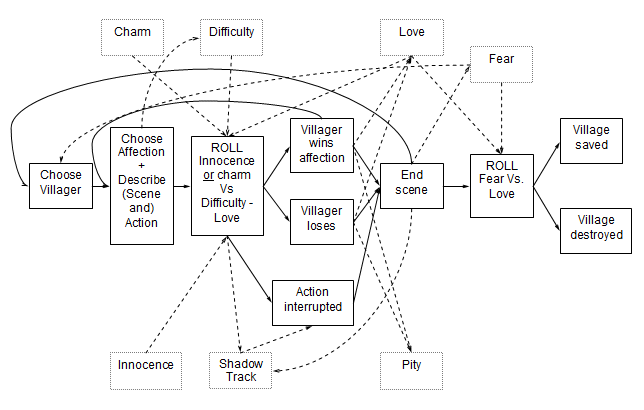
Here’s a flow-chart I made showing how Kagematsu is played, from a mechanical perspective.

Kagematsu flowchart

The solid lines and boxes represent game events and the flow of time. The dotted lines and boxes represent game stats and the flow of mechanical causation.

There’s a couple of things  I want to highlight here.

The first concerns Pity. In Kagematsu, in every scene a villager tries to elicit an affection from Kagematsu (the ronin); this is carried out through the mechanics shown schematically above. At the end of the scene, regardless of the mechanical outcome up to this point, Kagematsu’s player must decide whether to allocate the villager a point of Love or a point of Pity. That is represented on the diagram by the dotted arrows from “End scene” to “Love” and “Pity”.

Notice that while there are a couple of dotted arrows from Love to other bits of the diagram (Love is important in the game; it improves your chances of winning affections in future scenes, the Kagematsu uses it to confront the threat at the end of the game, and also, though this isn’t shown on the diagram, it shows who gets to go off into the sunset with Kagematsu if he defeats the threat), there are no dotted arrows from Pity to other bits of the diagram. What this means is that mechanically, Pity does not do anything.

But Pity is an important part of the game, because of the influence it has on player psychology. If we didn’t have Pity, the choice would be: award the villager a point of Love, or don’t. It seems pretty clear that this would lead to a lot more Love being given out, simply because the alternative is to do nothing. By introducing Pity, even though it has no mechanical effect at all, we give the Kagematsu a real choice – do you love this woman more than you pity her? It also makes the choice somewhat less controversial, since while one might be peeved at not receiving Love, one is probably more likely to accept that one deserves Pity.

The second point I want to highlight concerns the Shadow Track. Every time anyone rolls a 6 during a scene, that 6 is placed on the villager’s Shadow Track. If three 6s are placed on the Shadow Track, the scene is interrupted by the looming threat. The villager describes how the threat breaks the scene up. The villager does not receive her affection; indeed, it is as if she had never attempted to gain it.

The Shadow Track does have a mechanical impact, in that it nixes the last affection attempt and ends the scene prematurely. But the overall effect is to slow the game down a bit, rather than to actively push it in any particular direction. So while it’s less empty-seeming than Pity, it is fairly weak mechanically speaking.

But the constant risk that the threat will muscle in on a scene, and the occasional reminder that the threat is present, have an important psychological impact. They reinforce one of the central themes of the game and boost atmosphere. They remind everyone what’s at stake.

My point is, both of these are examples of good game design. On paper they look like mechanical dead-ends, failing to influence the key game outcomes much if at all. My initial reaction on reading them was to think the designer had made a mistake. But their psychological impact is important. I shall try to bear this in mind for my own design work.

Creativism

GNS theory cuts roleplaying creative agendas up into Gamism, Narrativism and Simulationism. The first two of these get more play, and greater respect, than the last, in my opinion. Yet I will argue this is because Simulationism has been misnamed; and in fact many important roleplaying innovations have been in a so-called simulationist space.

Quick disclaimer here: I’m going to talk about simulationism as described by Ron Edwards, but this is not really a theoretical article, and even though it tries to point the reader into a different view of what simulationism is, it isn’t any kind of attempted takedown of Edwards’s theory or other such shenanigans. Indeed it is rather selective in quoting Edwards, which would be a cardinal sin in a theory essay, but I hope I can get away with this in the above context.

The man who codified the concepts of GNS, Ron Edwards, talks about simulationism in his essay GNS and other matters:
Simulationism “is expressed by enhancing one or more of the listed elements [Character, Setting, Situation, System, Color]; in other words, Simulationism heightens and focuses Exploration as the priority of play.”

He talks about simulationism as focusing on exploration, a concept that is important to all roleplaying, but assumes pre-eminence and becomes an end-in-itself in simulationist play. Yet the term “exploration” is misleading. It implies a pre-existing reality which we together explore; or perhaps it is intended to imply a single fiction, probably created by one person, the GM. A more neutral term is creation, because that is in reality that which is being explored is simultaneously being created, whether by the GM or by the players, individually or collectively.

Similarly “simulationism” suggests an attempt to replicate some ideal – a realistic game world, a particular genre’s conventions, a well-realised character. But play that focuses on the act of creation (as opposed to exploration) need not be about simulating anything; it is often about the creation of imaginative, evocative content which might or might not relate to an ideal. Creativism would be a more accurate and comprehensive term for this type of play.

If we were going to do definitions, creativism might be defined as:
Creativism “is expressed by enhancing one or more of the listed elements [Character, Setting, Situation, System, Color]; in other words, Creativism heightens  and focuses the creation and development of the shared fiction as the priority of play.”

Now I’m not seeking to pick an argument with Ron or anyone else here. Instead, I’ll pause to note that “creativism” already probably sounds much more appealing to many roleplayers than “simulationism”, which is resonant with computer games and wargames – popular with some, but not with all. “Simulationism” hints at rules and dry technicality, while “creativism” points to imagination and shared endeavour. I’d also like to talk a bit about where that reframed concept leads us.

For one, it leads us to focus on questions about who creates the content of the game. Much of indie roleplaying design has been concerned with handing over creative authority, or at any rate extending it, from the GM to the rest of the players. Indeed, many indie games have no such distinction. This has some implications for the pursuit of drama (narrativism) and challenge (gamism) but its biggest impact is on the act of creation itself. It enables more people to take part in the act of creation, and thus plays into a creativist agenda.

We can go further. Creativist concerns lead us to look at how the act of creation is regulated. Drama points, games structured into acts, Dogs in the Vineyard’s traits, and many more, serve to regulate the flow of content creation. They serve other purposes too, of course; but one major impact is to shift creative power and constrain the creative act. This leads to the well-known paradox that one can sometimes be most creative when one does not have a free hand to create anything one wishes to.

I’m spending a lot of time thinking about these issues at present. And indeed, I’ve been teasingly referred to as a simulationist. Maybe I am – but these days I feel like I’m more of a creativist.

How to GM a GMless Game?

Ok, so this is a deliberately misleading title and could probably be more accurately described as how to facilitate a GMless Prepless game.

Originally I was skeptical of GMless, Prepless games but there are so many great examples of how to share creative control (e.g. Fiasco, The Trouble with Rose, Witch, 1001 Nights and A Taste for Murder) that I am far from worried that a GMless game world will feel flat and paper thin.  However I have noticed there is another aspect of GMless games which needs to be discussed more openly. This is the problem of “mental responsibility”.  Mental responsibility is the phrase I’ve coined to refer to many things in life such as who notices when the toilet roll is about to run out and ensures it is replaced before disaster strikes.

 
Mental responsibility for ensuring a game runs smoothly in GMed games is obvious, it rests with the GM.  The GM ensures a session is organised, that people know what to expect from the game, what dice (or not) they may need and it is the GM, ultimately, who takes responsibility for pacing the game.

 
There is no such obvious role in most GMless, Prepless games and there needs to be.  Just because the creativity is more equally divided up between the players doesn’t mean there isn’t a need for someone to take mental responsibility for the following things:

 
1. ensuring everyone understands the rules;
2. taking everyone though character and/or game world creation and answering questions;
3. noticing when pacing slips or rules are not being used properly and steps in to correct it;
4. actively setting an example of keeping people to a particular tone or ambiance in the game; and
5. noticing when one player is not getting sufficient screen time and bringing them back into the game.

(I am sure this is not an exhaustive list)

This doesn’t mean that you need to do all these things, just take responsibility for making sure they happen i.e. getting someone else to explain the rules.

If I introduce a GMless game to my gaming group then I always ensure I have read the rules, got the right amount of dice, dominos, character sheets and props and then manage the game to ensure it happens according to an agreed vision and in a way which maximises everyone’s fun.

Ultimately this comes down to the old and boring idea that things work more smoothly when one person is actively co-ordinating them. Unfortunately this means that someone has to do all the boring administrative work without getting the cherry of the creative control a GM enjoys. But I don’t think it is really that much of a hardship as you still get to play in a fun game – just one you have put slightly more work into than everyone else.

So my advice for GMless Prepless games is that GMless doesn’t mean rudderless or a total free for all.  GMless means no one person has overall creative control – but you still need to a pick a facilitator to carry out the background tasks which make a game happen smoothly.

My rule of thumb  – if you propose the game then you run it, where running means either GMing or facilitating.

 
This stuff might sound obvious but I have seen even the best written GMless Prepless games flounder without someone taking responsibility for getting it right. It is easy to assume someone else has taken on that role when they haven’t.


Further combat thoughts

So, further to my last article. I have been thinking about this a bit. I think that many of the criteria I set out are, fundamentally, compatible with each other. But I darkly suspect that my first and second criteria (Drama; and Colour and Impact) may not be entirely compatible with my third (Tactical Depth). This is because tactics implies detail and precision on positioning (whether spatial, temporal or otherwise within the fictional space) and, importantly, time to carefully consider combat decisions. Shall I attack this opponent, or that one? Shall I use this combat move, or this other one? All of this makes the fight more interesting from a strategy/gaming perspective, but crushes any sense of atmosphere and pace.

On a related note, I have been doing a bit of thinking about how fight scenes are portrayed in books and movies, and how this differs from the way it typically works in RPGs. One big thing that I notice is how <i>bitty</i> RPG combat is. It’s all “your turn, now my turn, now Bob’s turn” and nobody gets to build up a flow. A really dramatic fight scene in a book or movie is more likely to focus on a single character or small knot of fighting for a comparatively extended period, like a paragraph or two, and so we’re on the edge of our seats as that fight develops and we wonder who will live and who will die. We never build up that sense of anticipation in an RPG because when Bob is down to his last hit point we have to wait for everyone else to take their turn before we find out what happens to him. This is another area where incorporating this insight into an RPG system would tend to push us away from a tactics-focused system, because if we’re focused on one small part of the fight scene for a longer period, there’s less chance for other combatants to make tactical choices to break off what they’re doing elsewhere in the scene to intervene.

So, question for any system designer: which of these do you most care about? Drama or tactics? It isn’t like they are totally incompatible; you can have a sort of “summing up” phase after all the gubbins of tactical decision-making have been sorted to bring back the rich description of the action, or you can blend a kind of light-weight tactical system in with an otherwise more freeform affair. But there is a limit to this, and trade-offs to be made. I think there has been a lot of work in the first space (heavy focus on tactics, with description sort of crowbarred in), but less in the second – combat systems (as opposed to generic systems, remember) focused on drama, with less focus on tactics.

Whenever I think about operating in that second space, I start to get worried about descending into the generic. What I mean by that is: combat starts to feel like it doesn’t matter what decisions you are taking, as they are all mechanically the same. Does it matter whether I’m trying to kill this person or KO them, capture them, drive them off? It feels like it should. But in order to keep things simple and pacy, I find myself starting to design out those distinctions. I end up with “roll the dice, if you succeed impose a condition – give it a name, move on”.

I really want my fight scenes to feel dramatic. Grinding through a tactical battle scene can be fun – I enjoy war games, after all – but I’d like to be able to breathe life into fight scenes so they really feel edge-of-the-seat.

What games have you played that gave you a real sense of the excitement of a fight scene?

What I want from a combat system

So, if it wasn’t apparent already, I’m a system geek. I obsess about rule systems for RPGs. And none more so than the rules for combat.

Combat rules can be anything from “the players and/or GM describe what happens based on what they think would be cool and dramatic” to a sort of hyper-detailed miniature wargame. No matter. There are a list of things that I want to some degree or other from any combat system. Now, I think there’s a separate discussion to be had about whether some of these might be incompatible with each other; that’s for another day.

1. Drama. The whole point of having a separate combat system (as opposed to just using the bog-standard conflict resolution system for your game) is to deliver the suspense and excitement that a fight scene in any book or movie can provide. Will the hero live or die? Unlike most books and films, in an RPG that might be a question that could have more than one answer. The system needs to deliver that sense of drama and risk.

2. Colour and impact. A combat system needs to promote description that is rich and exciting. I want to feel like I’m in a fight. You might think any combat system can do this; it’s just down to whether the players and/or GM can manage to describe things in a sufficiently interesting way. Probably true to an extent – but there’s no doubt that a combat system can kill this off by encouraging a mechanistic “I hit him he hits me back” type dynamic.

3. Tactical depth. Being able to make interesting tactical decisions in combat and have them affect the outcome is an important part of why you bother having a combat system at all. You can do this (and many systems have!) through hyper-detailed battlemaps and oodles of options for special moves, feats and whatnot, or you can do this through a system-light approach where the GM and/or players assess the effectiveness of the tactics chosen and reflect this in the outcome described. The latter poses a risk, of course – I make what I consider a sound tactical judgement and the GM decides it wouldn’t work, for their own inscrutable reasons. Meanwhile the more “crunchy” approach ensures that there’s an agreed framework for making tactical decisions, but risks requiring unmanageable mechanical complexity in order to support a range of possible strategies. There are other ways of introducing tactics, through a kind of system-focused approach (like Dogs in the Vineyard’s see-and-raise approach), but these often lead to a focus on the dice at the expense of the fiction.

4. Realism. Controversial, this. It isn’t strictly necessary, but many of my gripes with commercial systems stem from a perception that they aren’t realistic in some way. Take D&D3e’s rule that smaller characters get a bonus to their hit rolls and a bonus to their armour class. Right: so in any given fight, the smaller fella is going to prevail, on average. Right? Let’s try putting the world’s best featherweight boxer in the ring with a mediocre heavyweight and see what happens, shall we? Of course, realism doesn’t mean you have to be hyper-detailed; there’s an argument that the players and GM are the best arbiters of what they consider realistic, so their own judgement is the best tool for ensuring a combat that has verisimilitude for them, without the need for reality-simulating mechanics.

5. Quick, smooth, easy to understand and reference. This is a basic requirement for any rule system. Systems which address tactical depth and realism best are often so mechanically detailed that they can be impossible for anyone without a maths degree to understand, take forever to look up and require five minutes just to count up the number of dice you have to roll. Needless to say, I do not consider this to be a good thing.

6. Supports a range of outcomes. Far too many systems are all about one party or the other being killed. Yet the majority of fights in real life are fought to subdue, intimidate, prove a point, force the defender to run away, and so on. For example, most RPG combat systems use rules for knockout and grappling which make these approaches very challenging in character (low chance of success) and also hard to handle out of character (mechanically complex). Again, not a good thing. I want it to be as easy for my cop character to cuff a perp as it is for my sniper to blow away a terrorist. Or whatever.

Phew! It’s no wonder I spend so much time thinking about this stuff – those are some challenging criteria. Anything else you look for in a combat system that I’ve missed out?