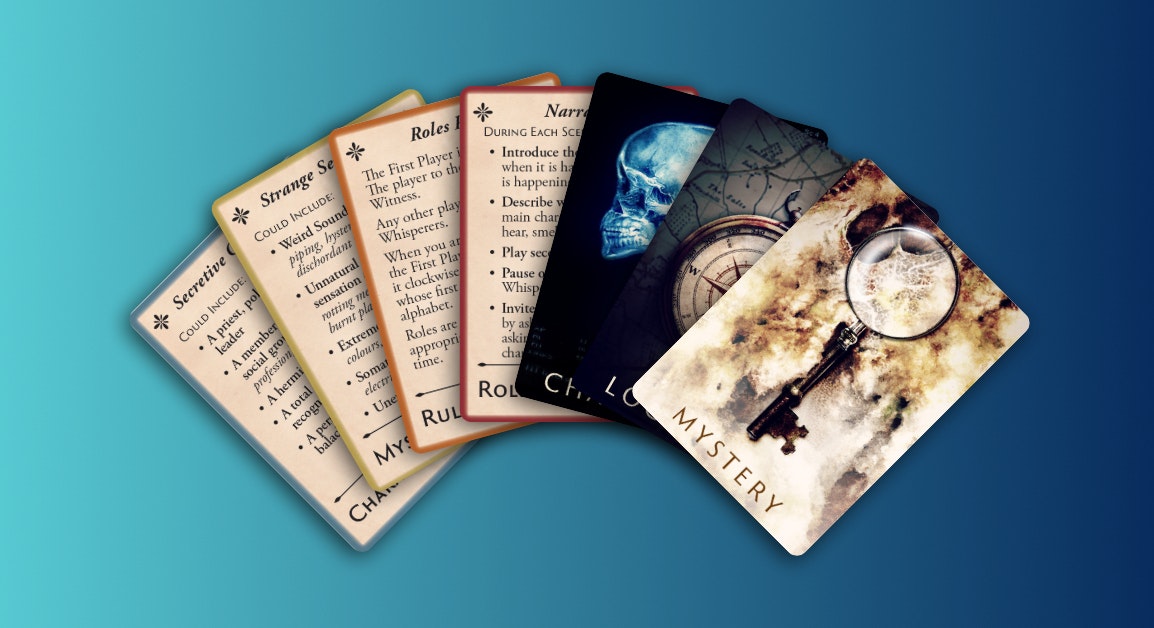
Puncturing the clue piñata

This article was originally published on the Black Armada Patreon – please help us create more great games and gaming content by becoming a patron!

The clue piñata is my name for a problem that sometimes happens with emergent mystery games like Brindlewood Bay. Essentially, the rules say wherever the players look for a Clue, they find one. That’s great! It’s a deliberate decision to avoid the classic problem in mystery games of the players struggling to find clues. But it can create a negative effect too: namely, that finding Clues feels too easy and not entirely realistic.

You walk into a room. You whack the Clue piñata. A clue falls out.

Walk into the next room. Whack the Clue piñata. Another clue falls out.

Look out the window. Whack the Clue piñata. Another clue falls out.

I’m exaggerating, but not by all that much.

The solution is rather simple: don’t let the players look for a Clue just anywhere. Ask them why they’re looking there, and how they’re going about it. They only get to roll if the answer makes sense.

In addition, feel free to set limits on how many Clues can be found in a given place. Ok, you searched the office and found a Clue. That means this place is now tapped out. If you want more, you’ll need to search somewhere else – or give an excellent justification for why they think there’s more information here that their first action didn’t turn up.

The effect of this is to increase the feeling that, even though we all know the mystery is improvised, it’s real. Because you have to describe how you’re going about looking for a Clue, and because that description needs to be good, it feels more like real investigation. Because you need to describe why you’re looking for a Clue there, and because that description needs to be good, the Clues feel more logical and more real.

Ex Tenebris, my gothic space investigation game (launching on Kickstarter in September), codifies this into the rules. The GM will only provide a clue if it makes logical sense to be able to find one – both based on the methods used, but also the context of the mystery: in other words is there any information here to find? It’s emergent mystery, so that question isn’t entirely based on GM fiat – if the players have a clear theory that there could be clues to be found, then there may be clues to be found. But they do have to have that theory – because if they don’t, the GM will look to their own ideas, and might well say “sorry, nothing to see here”.

Just because there’s no Clue in a place doesn’t mean there isn’t any useful information – Ex Tenebris distinguishes Clues from other types of information, so if the players go looking with a decent method but the GM doesn’t think there could be a Clue, they can still find something. What that something looks like will be covered in a later article.

In playtesting this has all worked really well. The process stops feeling like hitting a piñata, and starts to feel like, well, investigation. I think it would work just as well as an adaptation to existing emergent mystery games.

Ex Tenebris pre-launch is LIVE on kickstarter!

 Ex Tenebris is our new gothic space investigation game. Featuring the brand new Spawned from the Tenebrium system and a dark sepulchral space setting, it is coming to Kickstarter in September.

If you’ve been following our Patreon for a while then you’ve seen Ex Ten develop and read a lot about the thinking behind it – members can find loads of Ex Ten-related stuff here, including drafts of the game rules. There is more to come – watch this space!

We would love you to click on our Kickstarter pre-launch page and please share it around. If you like Dune, Warhammer 40k and Aliens or you know someone who does then let them know!

Ex Tenebris is open for playtesting

Today[*] we are revealing the incredible new cover for Ex Tenebris, our forthcoming gothic space investigation game.

The illustration is by Juan Ochoa, with logo by Andriy Lukin.

To celebrate, we’re launching our external playtest. We’re looking for folks to run the game with their group and feed back to us on how it went. The playtest pack will be ready in early February, and will include the full current game text, reference sheets and character keeper, and mystery scenarios. If you’re interested, sign up using the link below.

More on Ex Ten:

In the far future, civilizations have risen and fallen many times. The Republic Of Stars is the best hope for peace and enlightenment in a broken galaxy, a flickering candle amongst the ruins of better times. But it is fragile.

In the shadows are the plotters, the profiteers and the zealots. Behind them lurk worse things: demons, hostile civilizations and the malevolent artifacts left by ancient powers. Whether through selfishness or deliberate evil, they would tear the Republic apart and enslave its people.

Standing in their way is Moira, a small and overlooked government agency charged with investigating and bringing down the horrors that threaten the Republic’s people. You are the Guardians, Moira’s front-line investigators and fighters. Travelling the stars through an ancient and quite possibly sentient labyrinth, you hunt down the threats to the life and peace of the people of the Republic. They are the shield that protects us all from the terrors that stalk the void.

You are a member of a team of Guardians. You might be a power armour-clad Battle Angel, genetically enhanced for war; a necromantic Thanaturge, ready to draw on the secrets of death in defence of life; a hulking Relic, a walking arsenal left over from an earlier age; or a mercurial Shadow Walker, wielding an unseen knife to cut out evil.

Sign up for the playtest here:

https://forms.gle/YckP89NJ4RkxMeW36

[*] Actually a couple of weeks ago, but I forgot to post it on the blog!

GPSR for indie TTRPG creators pt2

Note: this article was updated on 16 December 2024 to reflect clear guidance that digital products are included.

EU Regulation 2023/988 on General Product Safety (henceforth, “the GPSR”) came into force on 13 December 2024. It’s a pretty big deal for anyone selling stuff in the EU – including, especially, if you’re in non-EU countries like the UK and USA – and it’s important for small creators to know how it works. This is hindered by the fact that the promised guidance hasn’t come out. Luckily the UK government has produced some guidance, but it’s fairly general and doesn’t tell you everything you need to know. The EU Blue Book is very handy if you want to delve into detail or understand definitions. This article collates the key points as I understand them, and explains how they apply in a TTRPG publishing context. Other industries might find it useful too, but if so that’s lucky rather than deliberate.

Obligatory caveat: I am not a lawyer or an EU law expert, even if I’ve started to feel like one over the last week’s research. This is not legal advice. You should look into this yourself. I am not responsible if you get something wrong in relation to GPSR after reading this article.

The GPSR is a set of legal requirements, intended to protect consumers from unsafe products, applying to all products placed on the EU market from the date the regulation came into force. It covers almost any physical product you might sell, as well as digital products. The only exceptions are some things that have their own dedicated regulations that take priority, like animal products (there’s a full list in that gov.uk guidance). The key question for most TTRPG producers is “does it cover books” and the answer is yes. It also covers card games, and basically anything else that might be a TTRPG, again with the possible exception of digital-only products.

The GPSR’s basic requirement is not to put products on the EU market that aren’t safe. But underpinning that requirement are a bunch of other things you have to do to demonstrate that your product is safe, and which TTRPG publishers aren’t used to having to do. These are the main focus of this article.

The GPSR is not new – there has been a regulation by that name since at least 2005 – but this marks a significant update which introduces some important new requirements.

Do I really need to do anything?

Legally, of course the answer is yes. Practically, it comes down to two things: whether you can get your product through customs and whether any retail distribution partners will accept your product.

As I understand it, customs are likely to be focusing on goods from places like China. It’s pretty unlikely that stuff from the UK or USA (the bulk of the non-EU TTRPG publishing sector I would think) will see much enforcement activity. But one doesn’t like to take risks. If customs stop your product and it doesn’t meet the relevant requirements then at best it’s going to slow you down, at worst there could be a fine. A consultant I spoke to suggested the fine could be 100-150 Euros (in theory the cap is way higher but you’re unlikely to hit that cap for a TTRPG). I’d rather not have my product delayed or pay even a relatively small fine if I can easily avoid it.

On the retail side, retailers and distributors have a legal responsibility to make sure their products follow GPSR. That means that the likes of Amazon, who sell into the EU, will want to make sure their products follow GPSR, and likely won’t take your product unless you can prove it’s compliant. So unless your entire business is selling direct to customers, you’ll want to comply.

Hobbyists

The GPSR only applies to products that are “placed on the [EU] market” (article 5), and according to the EU Blue Book (section 2.2) this means commercial products. The blue book goes on to say “Commercial activity is understood as providing goods in a business related context […] In principle, occasional supplies by charities or hobbyists should not be considered as taking place in a business related context.”

This is obviously very important since a lot of TTRPG creators are hobbyists. My reading of this is that hobbyists are exempt from GPSR, with the caveat that it’s very much an open question what counts as a hobbyist, and all the arguments about customs in the previous section still apply. Nevertheless if you’re making a few dozen copies of a zine more for fun than for money, there’s an argument here that you are not legally required to do anything in respect of GPSR.

What the GPSR requires for TTRPGs

As mentioned above the main requirement is that your product should be safe, but in support of that, as far as I can tell there are three key requirements from GPSR:

  • Produce and keep on file safety documentation including a declaration of compliance.
  • Have an EU-based representative who can deal with enforcement authorities if they come knocking (assuming you aren’t EU-based yourself that is).
  • Mark your product with certain GPSR-mandated information.

There are some other things that you might need to do in theory, but which in practice don’t require you to actually do anything. You need to ensure your product is safe – an obvious point, these are safety regulations. But the definition of safe is “under normal or reasonably foreseeable conditions of use, including the actual duration of use, does not present any risk or only the minimum risks compatible with the product’s use.” If your product is, like 95% of TTRPGs, a book, it is going to meet that definition, for adults at least. It’s not like you’re making an electric chainsaw or something. Also, you need to comply with product recalls. Again, not likely to be a problem. Needless to say, if your game does include a potentially dangerous item then that changes.

So the three bullets above are in practice what you need to do. Let’s look at them in more detail.

Documentation

The most complicated thing that is needed is a risk assessment. As mentioned above, most (maybe even all) TTRPGs are pretty well automatically safe, but you need to do a risk assessment anyway. I understand that there will be some harmonised standards in 2025. Until then, you’re stuck with common sense and careful thought. I haven’t yet thought through in detail what this might cover, but for books it is likely to feel like a statement of the bleeding obvious: product has no moving parts, no potentially dangerous energy source, no chemical components. It’s hard to think of anything dangerous about a book when used correctly, unless the ink is made of poison. You might want to check with your printer how they are managing GPSR compliance – they may have some off-the-shelf risk assessments of their own you can just take a copy of.

Everything else is pretty simple, though it is confusingly referred to as the “technical file” which is probably because they’re imagining your product is a machine or similar. For TTRPGs it isn’t actually terribly technical. Here is a list taken from a UK government-sponsored seminar on GPSR – with commentary from me in italics:

  • Manufacturer name, address, contact details – the publisher is the manufacturer, not the printer.
  • Responsible Person name, address, contacts (EU) – this is the EU-based representative, see next section
  • Brief description of product – I would think “250-page A5 hardcover book” would be a sufficient level of detail
  • Identification of product (E.g. an ISBN or batch number) – as it says, ISBN is appropriate, but if you have multiple printings you need to be able to distinguish them, I believe. The ISBN number and “Second printing” would be sufficient, for example.
  • Name, address, contacts of ALL facilities involved in design and production – for most products that is just the printer.
  • Name, address, contacts of notified body involved in assessing conformity of products – for most (all?) TTRPG products that will not apply, as you won’t be using a notified body.
  • Statement of Conformity assessment procedure followed – this is your risk assessment.
  • EU Declaration of Conformity – this is where you sign to say the product has been assessed as safe and complies with GPSR requirements.
  • Label and instructions of use of product – this only applies where a product cannot be safely used as intended without it – not a consideration for most (all?) TTRPGs
  • Relevant regulations to which the product complies – not applicable to most TTRPGs
  • Technical standards to which the product complies – not applicable to most TTRPGs
  • List of parts – not applicable to most TTRPGs – but will apply to e.g. card games
  • List of results – not applicable to most TTRPGs

As you can see, apart from the risk assessment, these are simple requirements to meet. Furthermore, if you use the same printer for multiple products, you can copy almost all of it over from one product to the next – just make sure nothing important has changed and you have up-to-date information from them.

Documentation needs to be retained for 10 years. Although not specified I assume this is from the point that the product is sold i.e. the duration that it is on the market plus 10 years.

EU-based representative

If you are EU-based, you can ignore this bit. Otherwise, there must be someone somewhere in the process who is responsible for liaising with enforcement authorities (GPSR article 16). This “responsible person” needs to keep on file the documentation referred to above, and their details must be marked on the product (this could include a sticker) when it is sold or, if that isn’t practical, on the packaging or an accompanying slip.

The responsible person can be a manufacturer (if you’re working with an EU-based printer that might be relevant), an importer (so e.g. a distributor), a fulfilment service or, if none of these apply, you will need to procure an authorised representative.

An authorised representative is a person specifically mandated to be your EU-based representative. There are already quite a few people offering their services for varying prices – cheapest for micro-businesses appears to be in the region of £250 per year. I met with a consultant who advised me that, if I have any EU contacts at all, I should consider asking them to do this for me, in order to avoid paying these costs for doing what a friendly EU contact described as “close to NOTHING”.

The authorised representative’s role needs to cover these things (taken from the UK govt-sponsored seminar I attended):

  • Authority to liaise with market surveillance authorities
  • Responsibility to notify manufacturer of any product issues when known
  • Responsibility to cooperate with market surveillance authorities to eliminate safety risks
  • Closely follow and comply with manufacturer’s written mandate
  • Provide market surveillance authorities with written mandate upon request

The authorised representative needs a written mandate. The aforementioned seminar advised this should include:

  • Name of parties to agreement
  • Purpose of agreement: AR is in EU, company needs to export to EU, AR is willing to represent company in EU, role of AR to liaise with authorities, company has created technical file for products and validated data
  • General terms: AR is independent of company, liability of both parties, governing law
  • AR status: appointment, list of directives covered, list of excluded directives
  • List of AR duties: storage, confidentiality, defective product claims, legal requirements, request for information, informing, immediate notification of product incidents, collating complaint information, cooperation in case of product risk, inspection by authorities, forward copies
  • List of company obligations: product recalls and advisory notices, compliance with applicable directives, EC Declaration of Conformity, technical documentation, information/assistance, use of AR’s name, technical file, insurance policy
  • Additionally: Fees, Address to be used, Requests, Changes, Duration of agreement, Termination, Signature fields

One note to this: since documentation needs to be kept for 10 years, it seems to me that the authorised rep needs to also keep them for that length of time – otherwise you could sell the product, and subsequently there’s a product recall, and the authorised representative won’t be able to do their job. So it follows that the mandate must specify this requirement – and, since you would probably like to be able to switch to a different authorised rep in future, that should include retaining documentation for products after that as well.

Product markings

Article 19 of GPSR says that you need to include this information on the product:

  • a batch or serial number or any other identifying element so that the consumer can identify it in an “easily visible and legible way”;
  • the name, physical address and email address of the manufacturer and (if different) the EU-based representative; and
  • where a product cannot be safely used as intended without it, clear instructions and safety information or warnings “in language consumers can easily understand”.

The batch or serial number is straightforward; as mentioned above it can just be the ISBN plus something to identify what printing it is, if there has been more than one. Your address is presumably straightforward and may already be on your products. The EU-based representative is trickier, because you may not wish to permanently print something on a product not knowing if you might one day switch to a new provider. I would suggest checking the terms of any contract with an authorised representative, and consider putting their details on a sticker or insert, or on the packaging, any of which I understand are acceptable.

The part that people seem most worried about is “in language consumers can easily understand” because it is taken to mean “must be translated into all the languages of the EU”. However, the instructions are the only part of this which would have to be provided in multiple languages. “Manufactured by” and “represented by” are considered to be widely understood, so you don’t need to translate them. Furthermore, safety instructions are clearly not required for a book’s safe use, nor I would suggest for any card game or even board game, as long as it doesn’t include anything like an electric chainsaw or similar. I would think for most (all?) ttrpgs, no instructions would be required, and therefore no translation would be required.

If you do need include an element in your product that requires safety instructions then you will need to consider this requirement further. I wonder if there is an argument that any product that is primarily English text is therefore aimed at English speakers and so it can be assumed that associated safety information in English will be “easily understood”. But that is speculation on my part – if you think you need safety instructions then you need to look into this in more detail.

Enforcement authorities

Cooperation with enforcement authorities is hopefully not something you’ll have to worry about but obviously if they contact you, you need to cooperate. This includes provided translated versions of the documentation shown above. I am told Deepl is very good for translating this sort of relatively technical documentation (warning: AI-based), or there’s good old Google translate (warning: probably also AI based I’m guessing).

Digital products

Thanks to a Q&A released by the European Commission, it is clear that digital products are included.

Side note: the Q&A isn’t on the main page for the GPSR regulations, nor is it easy to find by searching. I was pointed to the Q&A by a passerby on Bluesky. It would be super helpful if the EU (and government generally) could be a bit better at communicating this stuff.

It would be simple enough to ensure digital products are safe – the risks must be considered even lower than for books. I asked my consultant what risks I might consider in my risk assessment and she mentioned cyber security risks (which would be mitigated by using a reputable software to produce the product, for example). I also note that the regulation mentions “mental and social wellbeing” as factors in health, so it’s possible that is a consideration too – though of course remembering you’re entitled to consider the risk under reasonable conditions of normal use, and do not need to reduce the risk to zero.

As with other products, the authorised representative is the potential sticking point. There are plenty of people who are selling digital stuff on itchio, for example, who likely don’t make enough money to hire an authorised rep and might not have the contacts to find one for free. To those people I would offer one thought: as noted above, the regulation only applies to products supplied commercially – so if your level of activity could be regarded as nothing more than a hobbyist (tough to assess) then you might not be covered.

One other remark about TTRPG digital products. Unlike physical products they don’t go through customs, and they aren’t sold through EU retailers. So the arguments I made earlier on about the practical reasons why you need to comply are not applicable. Of course I would never suggest anybody break the law.

If you are selling physical products then you’re already having to comply on the physical side and complying with the digital side of things is pretty easy.

Toys and other things

GPSR applies to all products, but there are specific rules that apply to toys (the toy directive and associated CE mark). I have not covered these here. If your product is marketed at children under the age of 14, you should look into that. Just saying “this product is for people aged 15 and up” does not necessarily mean it doesn’t count as a toy – roughly speaking if it walks like a toy, quacks like a toy or is marketed at children, then it may just be a toy.

As mentioned above there are other rules for specific products. If for instance you were to include a small electronic device in with your game, you would fall foul of various types of dedicated regulations. This is pretty unusual for TTRPGs, but it does come up (ask me how I know).

Existing products

Legally, already-manufactured products that were on sale to EU customers before 13 December 2024 appear to be exempt. (In other words, if the product either first went on sale to EU customers after that date or completed the manufacturing process after that date, it’s not exempt.) A product, here, means an individual object – so if you do a reprint, that’s a new product. With that said, there is some uncertainty over this because of some ambiguous language in the EU Blue Book – it seems that products from outside the EU may be treated differently, although this isn’t clear. I discuss this further in my earlier article on GPSR.

Practically though, you may wish your pre-2024 products to comply with GPSR anyway. Otherwise, you are at risk of a customs officer holding up your shipments because they couldn’t confirm your product was exempt. If you meet the above requirements for new products, it will be very easy to do the same for existing ones, and will avoid the risk of this happening.

Conclusion

All of this is what we in the business refer to as a massive pain in the bum. I wish EU legislation were easier to understand, and better communicated, and that there weren’t loads of people trying to make money out of it. But once you look at the detail, it isn’t that hard to comply. The biggest issue is the authorised representative, because that can be very expensive for the smaller publishers, and all I can say about that is, solidarity friends.

Once again, this is just me writing down my own conclusions from my research – it isn’t legal advice, I am not a lawyer, please try and research your own obligations. And bear in mind this is (as you’ll have gathered) based on the assumption that you’re producing a TTRPG-type product, probably a book, and not an electric chainsaw.

GPSR for indie TTRPG creators

The updated EU General Product Safety Regulations (GPSR) are about to come into force and small businesses on social media are all of a kerfuffle about it. Understandably so. Apart from presumably updating the detail of product safety requirements, they require every product to have the manufacturer’s address printed on it, and for non-EU businesses to have an EU-based representative who has the job of providing paperwork to enforcement agencies, handling product recall requests, and so forth. Bit of a nightmare. Lots of people are saying they won’t sell to the EU anymore.

I have researched the application of EU regulations in preparation for GPSR. I don’t want to oversell this: I am not a lawyer, and I did it less than a fortnight before the regulations go live. Still, better late than never eh? Anyway, to be clear nothing in this article is legal advice, and neither I nor Black Armada games are liable for decisions you make; please do your own research. I’m sharing it to provide a (hopefully) helpful starting point for anyone who is trying to figure this out.

The principles I discuss below appear to apply to EU legislation generally, but obviously I’m mainly thinking of GPSR right now.

The key source, which every other source seems to be citing or basing their advice on, is the EU blue book.

The legalese

Here are some things the EU blue book says:

“— Union harmonisation legislation applies when the product is placed on the Union market and to any subsequent operation which constitutes making available until it reaches the end-user.

— Union harmonisation legislation applies to all forms of selling. A product offered in a catalogue or by means of electronic commerce has to comply with Union harmonisation legislation when the catalogue or website directs its offer to the Union market and includes an ordering and shipping system.” (page 15) [my emphasis]

And this:

“The product must comply with the legal requirements that were in place at the time of its placing on the market (or putting into service).” (page 16) [my emphasis]

The key definition of “placed on the market” appears to be this:

“A product is placed on the market when it is made available for the first time on the Union market. According to Union harmonisation legislation, each individual product can only be placed once on the Union market.” (page 19) [my emphasis]

And this

“— A product is made available on the market when supplied for distribution, consumption or use on the Union market in the course of a commercial activity, whether in return for payment or free of charge.

— The concept of making available refers to each individual product. A product is made available on the market when supplied for distribution, consumption or use on the Union market in the course of a commercial activity, whether in return for payment or free of charge. ( 43)

Such supply includes any offer for distribution, consumption or use on the Union market which could result in actual supply in relation to products already manufactured (e.g. an invitation to purchase, advertising campaigns).” (page 19) [my emphasis]

And this

“Products offered for sale online or through other means of distance sales are deemed to be made available on the Union market if the offer is targeted at end users in the Union“ (page 21) [my emphasis]

And this

“An offer for sale is considered to be targeted at end users in the Union if the relevant economic operator directs, by any means, its activities to a Member State. The assessment of whether or not a website located inside or outside the EU targets EU end-users has to be carried out on a case-by-case basis, taking into account any relevant factors such as the geographical areas to which dispatch is possible, the languages available used for the offer or for ordering, payment possibilities, etc. The mere fact that the economic operators’ or the intermediaries’ website is accessible in the Member State in which the end user is established or domiciled is insufficient (59). When an online interface provides for delivery in the EU, accepts payment by EU consumers/end-users and uses EU languages, then it can be considered that the operator has expressly chosen to supply products to EU consumers or other end-users.” (page 21) [my emphasis]

Note: According to this page, English is one of the EU languages.

Note the second: the above are excerpts from a massive document. There are quite a few caveats, complications and exceptions that I can see in there. Again, please do your own research.

Note the third: There is one key definition which is missing, and that is “product”. I have not as yet been able to find a sentence in the blue book which defines a product (at least not to my satisfaction) but the consensus seems to be that a product is an individual unit, e.g. a specific copy of a book.

My conclusions

Summarising the above, then: If an individual product unit which has already been manufactured is offered for sale online with delivery to the EU, payment from EU consumers and using an EU language such as English, then it has been placed on the market, and that is when EU law starts to bite; and it is the law at the time that the product is placed on the market which applies.

The new GPSR rules come into effect on 13 December 2024, so any product unit that was already manufactured on that date and offered to EU consumers as described above has already been placed on the market and is exempt from the new rules.

This also means – assuming I have understood the meaning of “product” correctly as discussed above – that if you manufacture a fresh batch of your product e.g. a reprint, then the latest laws apply to that batch. So if after 13 December 2024 you manufactured a fresh batch of a product that didn’t comply with those laws, and put it in a warehouse next to a batch of the same product that was manufactured before then, and if an EU customer ordered one of that product, you are breaking the law if you supply an item from the new batch, but not if you supply it from the old batch.

The same logic applies to other EU regulations, near as I can tell, but probably worth taking them on a case-by-case basis for safety’s sake.

One conclusion from all this appears to be: if you have a product that you know won’t comply with the updated GPSR, or simply don’t want to pay for a dedicated EU rep for that product, you could manufacture it and offer it to EU customers before 13 December, and it would be exempt. If you’re expecting to produce any fresh batches you might even want to keep some of the old ones in stock exclusively for EU customers, since those would continue to be exempt.

One wrinkle in this apparently neat conclusion is this section from the Blue Book (2.4): “Some products outside the EU can be bought directly by end-users in the EU online or through other means of distance sales. Although these products are deemed to be made available in the Union prior to any transaction for the purposes of checks by market surveillance authorities pursuant to Regulation (EU) 2019/1020, they are placed on the market at the moment an order by an end user has been placed and confirmed for a specific product already manufactured and subject of the transaction, and ready to be shipped.” On the face of it this seems to contradict the logic above, because it says that you can make a product available for the first time without placing it on the market. Frankly I find that rather puzzling – it muddies what otherwise seems a pretty clear picture.

This also suggests a further conclusion: if you crowdfund a product, it hasn’t been “placed on the market” until the product is manufactured. So that means if you crowdfunded it before 13 December but manufactured it afterwards, you’re on the hook for the new rules. On the other hand, you don’t need to pay for the EU rep (at least in respect of that product) until fulfilment time, which may buy some people a little time.

Once again, I am not a lawyer, this is not legal advice and you should not act on my conclusions without further research, but I hope this helps to navigate this legislation. If you’re in the UK you may want to keep an eye on the UK Government’s seminars on this subject – at the time of writing there’s one available to book here on 5 December. I haven’t attended this yet so it might be rubbish – if it’s massively enlightening I may post a refresh of this article after I attend it.

Rules do not elide

A rule can be a statement of what you can do, what you must do, or what you must not do, and it may also describe *how* you must do a thing. Rules have all kind of uses. In tabletop roleplaying games, one of those uses is to simplify arguments about how things ought to play out in the fictional situations we imagine and describe at the table. This has led to the claim that “rules elide”, and from what I can glean from the froth and din of internet discourse, some people think this is a very important claim*. But I am going to argue this is, at best, a partial representation of what rules do.

Why might we say that rules elide? Well, if you haven’t already, you can go and read the article where this idea was first publicly described (though it has now been deleted and is only available on backup, so don’t harangue the author** about it – which, come to think of it, don’t do that anyway). From reading that article, I take the essence of the “rules elide” claim to be this:

  • Without any rules, we describe the fiction in intricate detail, carefully characterising each little bit of what is happening. For example, we might describe each step, slip, swing and cut of a sword fight.
  • Rules enable us to shortcut that by instead rolling a die and saying “I win”, skipping out all the detail in between.
  • Therefore, rules elide the details of the fiction. Not necessarily all the details – and indeed, by eliding some parts, they effectively highlight what is left – but nevertheless, this is their role. Rules elide.

Whenever one describes another person’s argument there’s a risk that this leads to simplification or misrepresentation but I think the above is a fair summary of the “rules elide” argument.

The problem is that the first bullet isn’t true.

Without any rules, we might indeed describe the fiction in intricate detail. But we might not! In the linked article, an imagined player group describe the picking of a lock by working through the movements of pins and tumblers and whatnot. But that is certainly not how I would handle the picking of a lock. Here are a few ways I would think about doing it:

  • I might make a quick decision either way and describe what happens. “Nope, you can’t pick it, and your lockpick snaps.” “Cool, it opens.”
  • I might describe the lock and ask the player picking the lock what happens. “This is a top quality valyrian steel lock. How good a lockpicker are you, do you think you can open it?”
  • I might present a “yes, and” or “no, but” sort of approach. “Sure, you can open it, but it is going to take a while and you can hear the footsteps of the guards approaching, what do you do?”

You could of course argue that somewhere in there I’m using rules. My ability to “make a quick decision” rests on some rule, whether explicitly stated or implied, that I have a right to make a decision (probably because I’m the GM). But in reality if we started trying to roleplay together without discussing any rules at all, it is very very likely that at some point someone would skip over most of the fictional detail and make such a decision. Indeed, the decision to say “you find a locked door” is such a moment. The casual elision of details is actually a fundamental part of storytelling and imaginative play, regardless of whether you think there are rules involved.

So it’s not the case that roleplaying without rules is inherently very detailed.

But more than that: rules can actually supply detail where none would otherwise exist.

Consider the classic case of a game of cops and robbers. “Bang bang! You’re dead.” “No I’m not!” In this game, we skip over enormous amounts of detail. I point my two fingers at you and say bang bang, you fall over or you don’t. At no point do we consider what kind of gun or ammunition we’re using, what armour we might be wearing, how good my aim is, the potential elements affecting my aim such as distractions or (at longer ranges) wind. We are eliding the heck out of that gun fight.

I defy anyone to look at the crunchier roleplaying game manuals and tell me that these games elide compared to this simple roleplaying activity. Looking at my old copy of Shadowrun 4th edition, I see 2 and a bit pages of rules for adjudicating initiative, 6 and a bit pages of rules for different types of ranged fighting, plus 9 pages of details about different types of ranged weapons (with pictures!) This is not eliding *anything* relative to how I would normally conduct a firefight in a roleplaying game; in fact if I take it seriously as a set of rules, it enormously expands the level of detail and precision I would use in narrating such a fight.

So at the very least, I think we have to say that rules don’t always elide. Perhaps they are always eliding compared to some perfect simulation of reality, but that is certainly not the default or most commonly observed state of imaginative play when unmediated by rules.

What, then, will we say about rules? Rules are a way of guiding the conversation. We can drill into the details we find interesting, as Shadowrun players presumably find weaponry. We can skip over the details we don’t find interesting, as many other games do with the details of the same weaponry. We can remove arguments over who went bang bang first and who is now dead. We can specify how decisions should be made, and who gets to narrate the outcome of those decisions, as when Forged In The Dark tells us who gets to decide what dice to roll and who gets to decide the level of risk and effect. We can quantify things that would otherwise remain vague, as with hit points in D&D or sanity in Call Of Cthulhu. We can introduce details that don’t exist in the real world, like the characteristics of a monofilament whip. We can force the conversation at the table down particular lines, as when in Ten Candles, if the last candle goes out, the characters die regardless of what they may have had planned. We can force a player to describe something they hadn’t even thought about until a moment ago, as when in Apocalypse World a character is suddenly asked to tell us their secret pains.

Rules can sometimes elide. But more often, rules specify. Rules focus. Rule describe. Rules intrude.

Rules are a magical way to shape our conversation at the table, to direct play and to bring imagined worlds to life. Used unwisely they can be blunt instruments that get in the way of good storytelling. But the best rules help us tell stories we almost certainly wouldn’t have told otherwise. They mostly don’t do it by eliding.

If you enjoyed this blog article, please encourage me to make more by supporting the Black Armada Patreon.

*Side note: I am far from the most up-to-date person on internet discourse. I think this claim may be fairly old, at least by the frenetic standards of discussion on X and other such places. I’m sorry if I sound like an old man shouting at clouds.

**Which, to be clear, I have no idea how important the author thinks “rules elide” is as a statement or how sweepingly they intended to make that statement. Perhaps this entire article is a statement of the bleeding obvious – ironically I kind of think so. Still, discourse eh?

Lovecraftesque second edition is available to pre-order

Lovecraftesque. The eldritch horror roleplaying game where you create the mystery at the table. Pre-orders now open. Image shows the Lovecraftesque box cover with a skull-like monster lurking behind a lone character in the woods. Alongside this are the new rulebook with a striking red-and-white cover, and a spread of cards from the new edition.

Lovecraftesque second edition successfully crowdfunded in late 2023. You can now pre-order it here, or if you’d like to know more, read on!

A Storytelling Card Game Of Eldritch Horror

Lovecraftesque is a storytelling card game of creeping cosmic horror, emulating the tone and pace of eldritch horror stories. The game will guide you to create the story of a lone individual who stumbles upon clues to a terrible evil. It creates slow-building, brooding horror that the main character at first dismisses, until all too suddenly it becomes impossible to deny. The ending will certainly be bleak, and the main character is likely to meet their doom.

A mock up of the cards used to play the game
Brand new cards help streamline gameplay and inspire your group

Lovecraftesque is an emergent mystery game, which crafts a story out of clues that you take turns to create. The game includes hundreds of creative prompts to help you generate your story and guide the main character towards a confrontation with cosmic evil. You take turns to drip weird events into the story, building up your mystery one clue at a time.  Each player creates a secret theory about the horror and the truth about the horror emerges from those theories. By the end you’ll reach a chilling climax that none of you could have predicted at the start.

Lovecraftesque is easy to learn and teach, simple and intuitive to play, with hundreds of prompts to fire your imagination. It can be played with 1-5 players in around 2 hours.

Lovecraftesque is created by Josh Fox and Becky Annison of Black Armada Games, the award-winning publishers who brought you Wreck This Deck, Last Fleet, Flotsam: Adrift Amongst The Stars and Bite Marks.

A mock up of the Lovecraftesque core box
A New Edition

We created the first edition of Lovecraftesque back in 2015. It was our first game design project and we were delighted with its success. It’s received critical acclaim, won awards and gained thousands of fans around the world. But we were new to publishing then, and the costs and risks meant we were unable to realise our full vision for the game. In this new edition we’ve created the game we always wanted to.

The second edition is fully card-driven. It gives your group more support for their creativity through prompt cards that help you get your story set up and populate it with interesting clues, characters and locations. The story will seem to write itself.

There are also brand new card-based scenarios to get your story off to a flying start. Check out the scenarios list to see the incredible range of fresh exciting settings for eldritch horror, written by a diverse slate of talent from across the industry. Like the rest of the game, these are written on cards, meaning you can easily mix and match to make up your own weird tales.

With the new card-driven approach the game is even easier to learn, teach and play. The rules and structure of the game are written into the cards and your progress is tracked on the board, so you always know what you’re meant to be doing. As always we include teaching text to make it easy for you to learn and teach the game at the table, and tools to avoid the stereotypes of Lovecraft’s own work.

We are also commissioning new art by Vincent Sammy and Paul Tomes to make the game look cooler than ever before.

Lovecraftesque second edition will be available as a boxed set with the rules and all the cards you need, and as a virtual tabletop for online play.

Lovecraftesque is crowdfunding from 10 October to 9 November 2023. Pre-order now and become one of the first to back the project!

Lovecraftesque second edition has brand new scenarios!

We are just 24 hours off the launch of our crowdfunding campaign for Lovecraftesque second edition. If you are excited for the new edition you should follow the campaign now so you can back as soon as the campaign goes live!

As part of the new edition, we have commissioned a ton of new writers to create brand new scenarios for the game, as well as writing a bunch ourselves and updating a few of the scenarios from the first edition. They really are incredibly diverse – not just the writers themselves, but the fresh and exciting settings that they have brought to eldritch horror. I don’t think you’ll find a more unique and original set of cosmic horror scenarios anywhere (though the first edition of Lovecraftesque gives it a run for its money!)

The new scenarios come on cards, just like the rest of the game’s creative prompts, and provide pre-generated characters, locations and clues that you can use to create a story with a distinct flavour. These aren’t pre-plotted adventures, but rich ingredients that you deploy at the table to create your own eldritch mystery. Whenever you use them, they’re mixed in with some standard cards from the core game. As a result, every play through is different, and every scenario is infinitely replayable.

More than that, you can recombine the cards in the scenarios with each other and with those in the core deck to create scenarios of your own. With about 240 cards across the scenarios, it is an awesome bank of cosmic horror ideas and prompts.

Here is the full list of scenarios.

  • A Place In The Country by Lynne Hardy. The Norton Hotel Consortium plans to turn Rowan Hall into a luxury hotel and spa. But what mysteries lurk within the dilapidated hall and gardens? And why is its current owner so desperate to sell? 
  • A Witch’s Love by Michele Gelli. Caterina Sforza (1460~1509), ruler of Imola and Countess of Forlì, political leader and alchemist, was a tough cookie. She held hostage the Vatican’s conclave and she’s said to be a witch who had a well to dispose of bodies of “discarded” lovers. Can Caterina’s presence cross space and time? Can her love change the destiny of a team of archaeologists that are investigating her old castle?
  • Atlantis Swallowed by Becky Annison. Thousands of years ago and the sea levels are lapping at the heels of Atlantis. With greater technological prowess than anything a modern civilization has seen, they are confident they can hold back the waters. But a deeper rot has seeped in through the cracks.
  • Blow Ye Winds by Sasha Sienna and Jonathan Sims. In 1831, the British port of Peterhead processed the butchered blubber of over a thousand whales a year, hunted and killed off the coast of Greenland. Dr Andrew Campbell has left his landlocked life behind to serve as surgeon on the whaling vessel Sanguine, but his first voyage will not be an easy one as a strangeness begins to affect the ship.
  • Echoes of Vulcan by Darla Burrow. It is strange days in Pompeii. Phantoms walk the streets, doors open to tunnels where once they opened to courtyards, and birds fall dead from the sky. Something awful is coming, but what is it and how does it connect to the mysterious Cult of Mithras?
  • Ex Nihilo by Joshua Fox. A spaceship is sent to explore the last frontier of science by entering the black hole V616 Monocerotis “Mon”. The journey into the singularity is even more terrifying than expected.
  • Mr Giggles Comes To Dinner by Misha Bushyager. Your kid won’t shut up about their ‘imaginary friend’s’ exploits. So far, so normal, until you start experiencing them too.
  • Nothingness has a thousand endings by Bryan Thao Worra. In this scenario, the witness takes a step into the 1990s Southeast Asian refugee community in a working class neighborhood in the US to resolve a mysterious debt of uncertain consequences.
  • On Ilkla Moor Bah’tat by Becky Annison. Ilkley Moor is a dark and foreboding place for a young world war II evacuee miles from the city she called home. What lurks in the soothing waters of the suspicious Hydro Hotel and are the locals friendly or ready to offer her up on a plate?
  • The Chicxulub Horrors by Santiago Villa. In the coast of Yucatán where an ancient meteorite has created a gargantuan underground crater that is now a web of tunnels, a man disappears. During the art boom of the 1930’s in Mexico, painter and muralist Hervé Pelletier has gone missing and his wife, Amaranta Vera, has arrived at Chicxulub Puerto, a town nestled over the crater’s dead center, to look for him.
  • The Hidden Cabinet by Helen Gould. A scenario about whispered rumours, duplicitous politicians, and what really happens in the corridors of power. What will you find behind these closed doors?
  • The Sea Hungers by Thomas Manuel. It’s Bombay in 1728. As the East India Company recovers from a ferocious defeat at the hands of legendary pirate admiral Kanhoji Angre, a naive, young marine discovers a sinister plot involving sacrifice and spirals of blood.  
  • We serve and protect by Kenneth Hite. A long hot summer of protests rocks the streets of Chicago in the 1970s, and you rock with them. Until the cops pen you in, snatch you up, and take you to the precinct house, where worse things than rubber hoses wait in the basement. The Chicago Police Department serves and protects… but what inhuman entity do the cops who have you serve? What dark secrets do they protect?
  • Wolfshead by Joshua Fox. Sherwood, Nottinghamshire, in the 13th century. A hapless cutpurse robs the wrong person and finds themselves in possession of a strange item. Now they have the Baron’s men hunting for them – but that may not be the worst thing that stalks the night.
  • The Copycat Canal Murders by Becky Annison. Ritual murders spanning a century are investigated again in the age of DNA profiling and AI. Will the truth of the horrifying secrets on the foggy banks of the canal finally be revealed?
  • The Outer Gods by Nick Bate. The year is 23XX. Humanity has colonised the Solar System aboard reality-rending liveships, warding themselves against unearthly things hiding in the dark through ritual and prayer. Monette is one such liveship, a salvager investigating the sudden reappearance of a lost generation ship. What will they find aboard the deadship Yog-Sothoth?
  • The Siren’s Caw by W.H. Arthur. Every summer, visitors from London and beyond are drawn to the seaside resort of Brighton. Are they called here by the eldritch forces from beneath the waves, or is there something even more sinister from across time and space?
  • Through The Waters, Darkly by Josh Fox. A research and exploration base has been set up at the bottom of the deepest place on Earth: the Mariana Trench. The small team of scientists are isolated in the cold depths as they explore the last frontier of our planet. Isolated, yes: but not alone.

Lovecraftesque second edition launches on Backerkit crowdfunding tomorrow – Tuesday 10 October, at 11am ET / 4pm BST. Follow the campaign and be one of the first to back the new edition.

Lovecraftesque 2e has hidden UV art!

We’re ONE WEEK away from the launch of the Lovecraftesque 2e crowdfunding campaign and, to celebrate, I want to share with you a very exciting part of Lovecraftesque 2e which is *hidden UV art*. The new edition will come with a UV torch, and when you shine it on the box, board and rulebook you’ll see extra detail that was invisible before.

The cover of Lovecraftesque shows a lone figure investigating some weird-looking cocoons while a skull-like monster lurks behind them.

When you turn the torch on, extra detail is revealed: tentacles, egg sacs and a summoning circle centred on the figure.
A mock-up of what the UV cover will look like

We first saw this approach in the Italian edition of Lovecraftesque 1e by Narrattiva, and we’re stealing it wholesale. Every illustration will contain hidden details and the text itself will be splattered with sigils, blood stains and tentacles. Check out the Italian edition cover below – you’ll be seeing something very similar on the new edition’s rulebook.

The Italian edition of Lovecraftesque 1e

The art for this game is going to be SO GOOD. You’ve seen the awesome cover by our lead illustrator Vincent Sammy, who also illustrated Bite Marks. There’s more where that came from. Check out this gorgeously creepy illustration for the game’s board, also by Vincent Sammy – shown here with its UV art.

The board for Lovecraftesque 2e.

And we also have Paul Tomes creating interior illustrations for the book. We’ve long admired Paul’s style and we’re really excited to have him on board. Take a look at this terrific piece showing horror about to unfold in a mine. Again, there will be UV on this one, but you’ll have to wait to see that.

A cross section of a mine, with tiny figures dressed in high-vis. Lurking behind the rock face are enormous tentacles about to break through.
One of Paul Tomes’ illustrations for Lovecraftesque 2e

As always, commissioning art for games is my favourite bit about being a small press publisher. It’s always delightful to see our weird ideas turned into something gorgeous, and to support artists while doing it.

The campaign for Lovecraftesque 2e is here.

Lovecraftesque 2e: what’s new

We are just TWO WEEKS from our crowdfunding of Lovecraftesque second edition (you can sign up to be notified when the campaign launches here). There are a ton of exciting things to share about the new game and I’ll be announcing them day by day.

But let’s start really basic: what is new in the game’s core design?

It’s still a GMless storytelling game where you share control of one main character, and also share the job of creating the clues that drive the mystery. It’s still about slow-building mystery culminating in worldview-shattering horror and a bleak ending for the main character.

But the game now comes with a plethora of prompts to help you create the characters, locations and clues.

You get a dedicated deck of Location Cards with prompts to generate the places where the horror unfolds, and a deck of Character Cards with prompts to create NPCs your main character might encounter. The two of these together help you rapidly generate the setting for your game; perhaps you’ll be presented with a Holy Place, a Remote Location and a Natural Feature and immediately think to yourself “that sounds like a monastery in the mountains”. Once you’ve decided your basic setting, the cards enable you to create a bunch of ready-to-go story elements that you can grab and quickly turn into a scene.

Then there’s the Mystery Deck, which is the engine that drives the unfolding mystery. The Mystery Deck contains Clue Cards with a theme for a Clue. Themes like technology, strange writings, weird construction, and rites & customs. With each card, you can straight away imagine the sorts of eldritch weirdness you might create. But to make it even easier, the cards contain a handful of prompts that you can quickly flesh out to turn into a Clue.

The Mystery Deck also contains Special Cards, just like the ones in the first edition of the game, that allow you to break the rules. These shake up the story so that just occasionally the main character will get killed midway through the story, and pick up a new character; or, even more surprising, they might actually defeat the horror at the end.

The game also comes with scenarios, just like the first edition, written by a diverse international slate of authors and covering fresh and varied venues for cosmic horror. What’s new is, the scenarios are written on cards. This makes it simple to set up the characters and locations where everyone can see them, and dish out the clues to the group. Further, you can recombine the scenario cards with cards from other scenarios and those from the main deck to create your own scenarios, and for infinite replayability.

The scenarios aren’t stretch goals: we’re funding them as part of our main goal. There will be a set included in the main game, and more available as expansion packs. We’ll be announcing details in the coming days.

Alongside those you have the Story Track and Story Cards, which guide you through the game. They serve a similar role to the teaching guide in 1e, walking you through each part of the game so you always know what to do next. This is a bit like the way games like For The Queen present each new step of the game on cards, making it simple to follow the structure of the game.

We haven’t got rid of the teaching guide, by the way – we know this was a favourite feature of the first edition. What we have done though is integrate it into the rulebook so that the whole text is now presented as a read-out-loud guide.

Finally you have Rule Cards which describe the key rules of the game – things like the creeping horror rule which limit how extreme the clues can be. These serve as a handy reference but also help to highlight when the rules change mid-game – it’s very satisfying to discard the rules that have been limiting the horror and know that the leash is off!

All this makes for a hugely improved experience: better creative support, slicker, easier to learn rules, and a more accessible game. I’ve successfully taught and played a full session of Lovecraftesque in 90 minutes and the group was BUZZING with how much fun they had and how easy it was to pick up.

I’ll be back with more over the next two weeks. In the mean time, if you haven’t already, you should get yourself signed up to be notified when the project launches. Don’t miss it!